Air, where pupils gather.
Air systems need power and no plumbing, so a station can stand where pupils actually spend their breaks. The Air Stand Pro delivers cold water only, 30 litres a day on average.
Free-flow stations where pupils fill their own cup or bottle, hot water in the staff room, and a supply that does not stop when a delivery is late. Filtered and remineralised on site, from the water line or from the air.
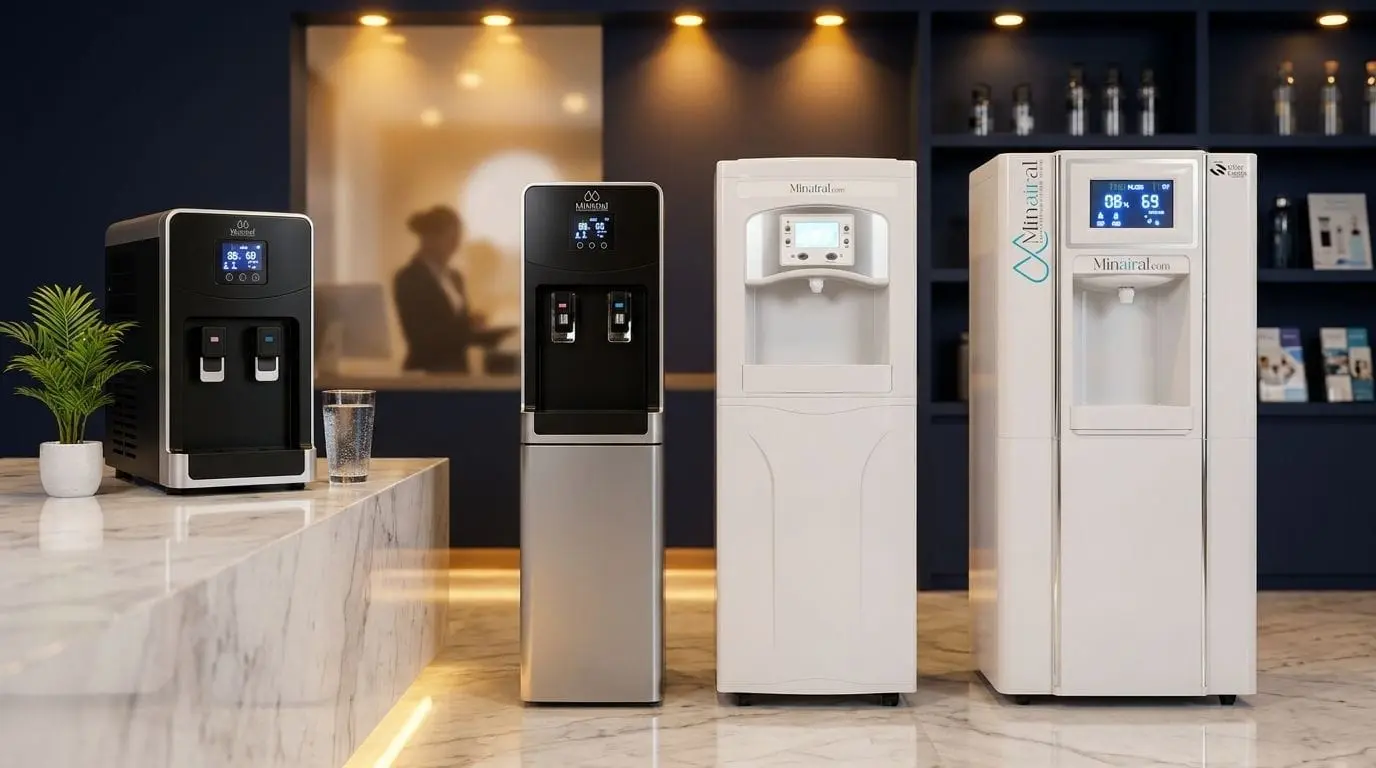
A school drinking water station is a point-of-use system that pupils use themselves, many times a day. That changes what matters compared with an office or a hotel.
Stations where pupils actually are, at break and after sport, so a drink of water is not a trip to the office.
Water for the whole school day, every day of term, with no gallon running out in the middle of the afternoon.
Parents and school boards ask what is in the water. The answer is documented: reverse osmosis, four minerals restored, TDS and pH checked, and a yearly laboratory test available.
Hot water belongs in the staff room and the kitchen. The floor-standing Air Stand Pro delivers cold water only.
Small children drink little and often, all day. A free-flow station gives them water whenever they need it.
No bottles to buy, and none in the bins at the end of the day.
Pupils and adults are served differently. Cold free-flow stations go where pupils gather, hot and cold units where staff work.
Air systems need power and no plumbing, so a station can stand where pupils actually spend their breaks. The Air Stand Pro delivers cold water only, 30 litres a day on average.
Pure connects to the school water line and delivers a stable volume every day. Five-stage reverse osmosis, remineralisation, continuous UV-C sterilisation and internal recirculation. It is what the kindergarten in our projects list runs.
The method published on this site counts 2 litres per person per day over 365 days. A school is open fewer days than that, and young children drink less than 2 litres, so read the figures as an upper bound and scale them to your calendar.
Whichever count you use, the gallons stop: no deliveries to receive at the school gate, no heavy containers for staff to lift, and no empties to store.
Change the headcount or the format in the impact calculator.
Every system filters by reverse osmosis at 0.0001 micron, then restores calcium, magnesium, potassium and sodium through a Biocera mineral filter. The result is alkaline, pH 8.5 or above, with 40 to 80 ppm of total dissolved solids.
TDS and pH are checked during routine maintenance. Under the business service plan, the water produced on site can be tested once a year by an independent ISO 17025 accredited laboratory, and the report is available on request, for the school board or for parents.
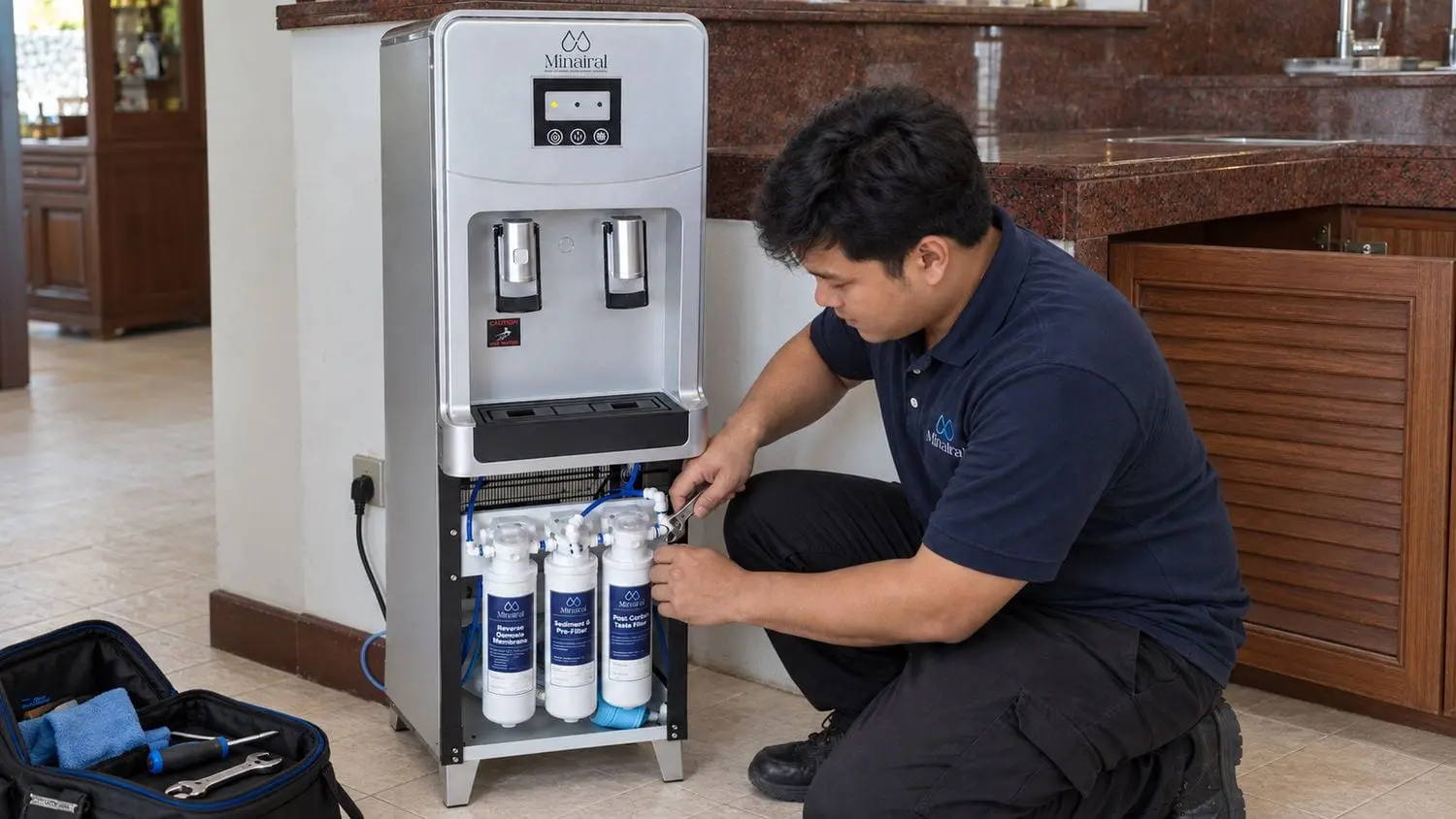
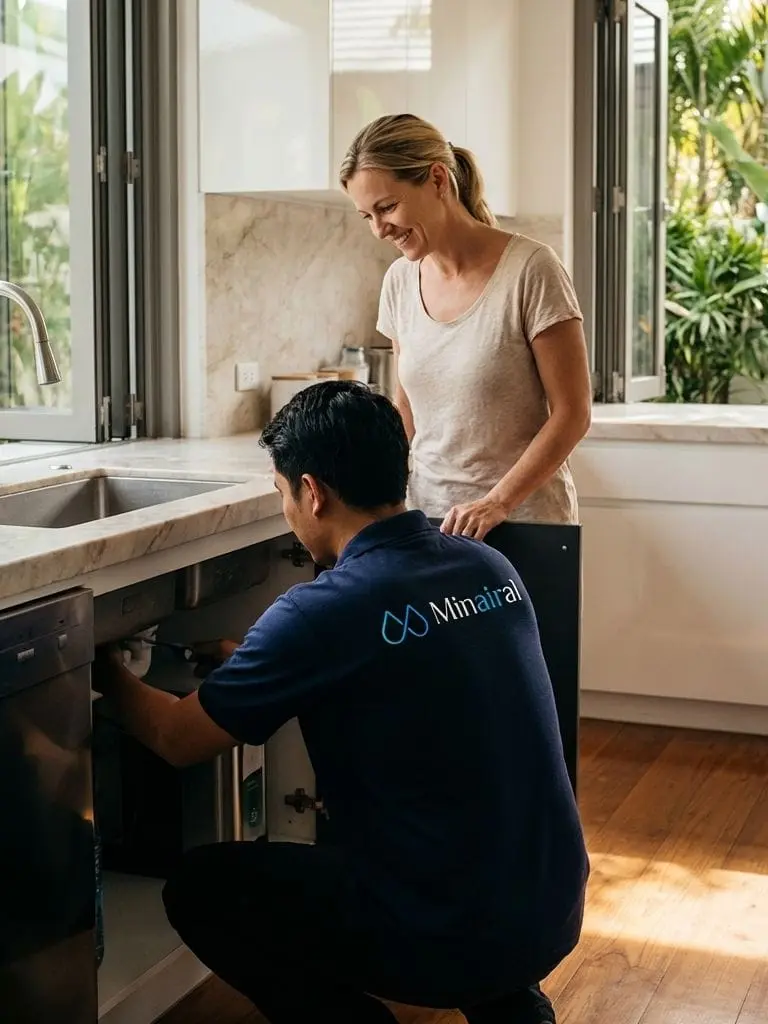
Maintenance follows a schedule agreed with the school. Technicians work Monday to Saturday, so visits can be planned around lessons.
From the installations listed on the projects page. Client names are withheld at their request.
It depends on the number of pupils, the buildings and where pupils gather, so it is set at the site assessment. As an upper bound, 100 people at 2 litres a day need 200 litres. An Air Stand Pro produces 30 litres a day on average, and a Pure system is sized for around 22 litres of daily use.
Pure systems deliver hot water at 90°C and cold water at 4°C. The Air Stand Pro delivers cold water only, which suits areas where pupils serve themselves. Which unit goes at which point is agreed at the assessment.
TDS and pH are checked during routine maintenance. Under the business service plan, the water produced on site can be tested once a year by an independent ISO 17025 accredited laboratory, and the report is available on request.
Yes. A kindergarten in Koh Samui runs Pure free-flow stations, listed among our projects. Small children drink little and often, and a free-flow station gives them water whenever they need it.
Not for every station. Pure connects to an existing water line in under an hour. Air needs no water connection, only power, so it can stand in a corridor or a covered play area.
Three service centres with parts in stock, in Koh Samui, Phuket and Hua Hin, and service coverage in Bangkok and Koh Phangan.
Head office, showroom and service centre in Bo Phut. Koh Phangan is served from here.
Service centre in Chalong.
Service centre in Hin Lek Fai.
Service coverage, served from our network.
Number of pupils and staff, buildings, where pupils gather and where the water lines run. You receive a configuration, a capacity and a maintenance plan.