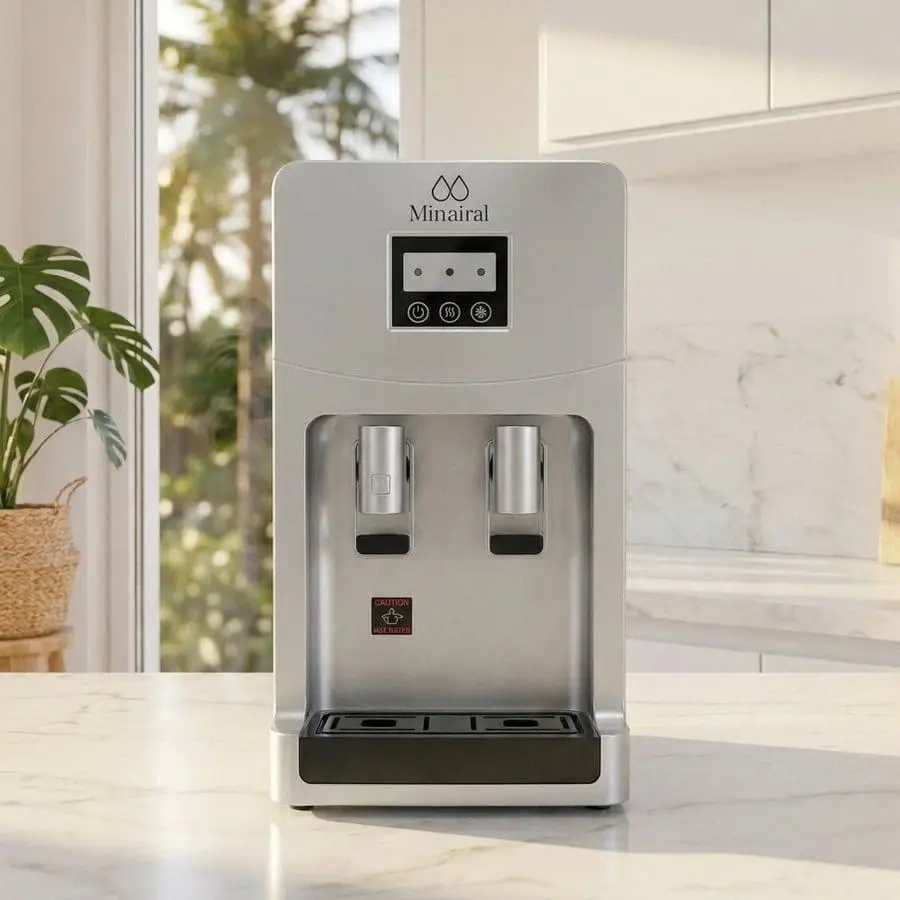
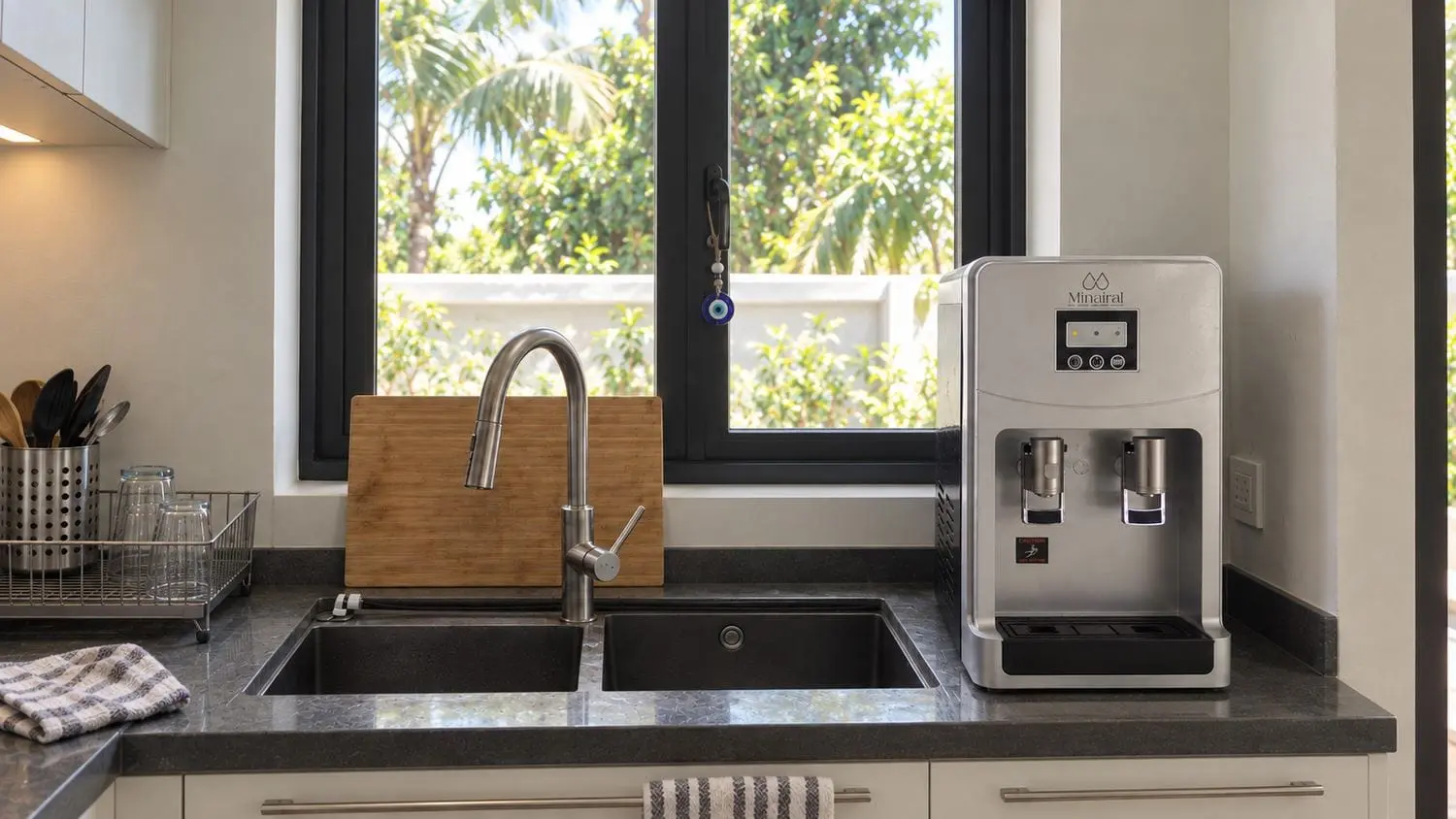
Pure Countertop, see this model on the online shop
- FormatCountertop
- Tanks7 L, stainless
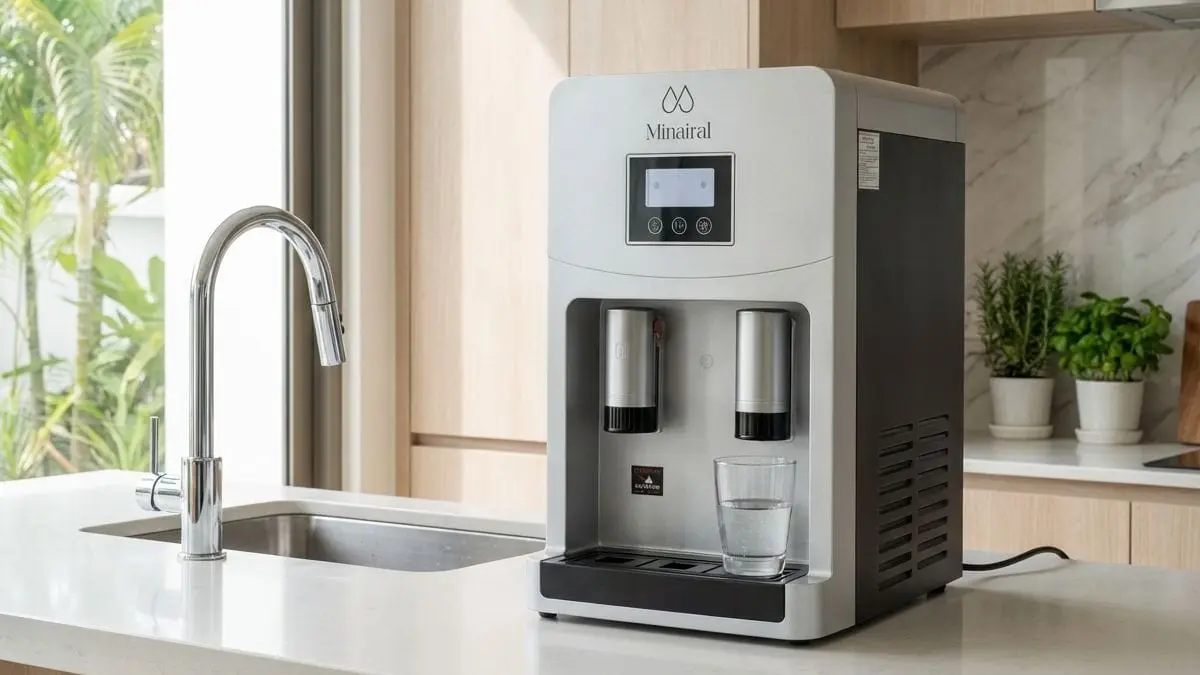
The Pure range turns your existing water line into mineral drinking water. Five-stage reverse osmosis, remineralisation, continuous UV-C sterilisation, and delivery at 90°C and 4°C.
A reverse osmosis drinking water system pushes water through a membrane fine enough to hold back dissolved contaminants. The membrane in Minairal Pure systems is rated at 0.0001 micron, and it removes heavy metals and dissolved contaminants from the incoming water.
Reverse osmosis also removes minerals. Pure systems put four of them back, calcium, magnesium, potassium and sodium, through a mineral filter using Biocera technology from Korea. The water is then held in stainless steel tanks and dispensed hot or cold. Because the source is the water line, output is stable and does not depend on humidity or the weather.
From the water line to the glass, in this order. The full detail, with replacement intervals, is on the water quality page.
Reduces sand, rust, dirt and chlorine taste, and protects the stages downstream.
Filtration at 0.0001 micron, rated at 75 GPD, roughly 12 litres an hour.
Final polishing stage. Improves taste and smell.
Restores calcium, magnesium, potassium and sodium, for an alkaline pH of 8.5 and above.
Continuous UV-C sterilisation and internal recirculation protect the stored water before it is dispensed hot or cold.
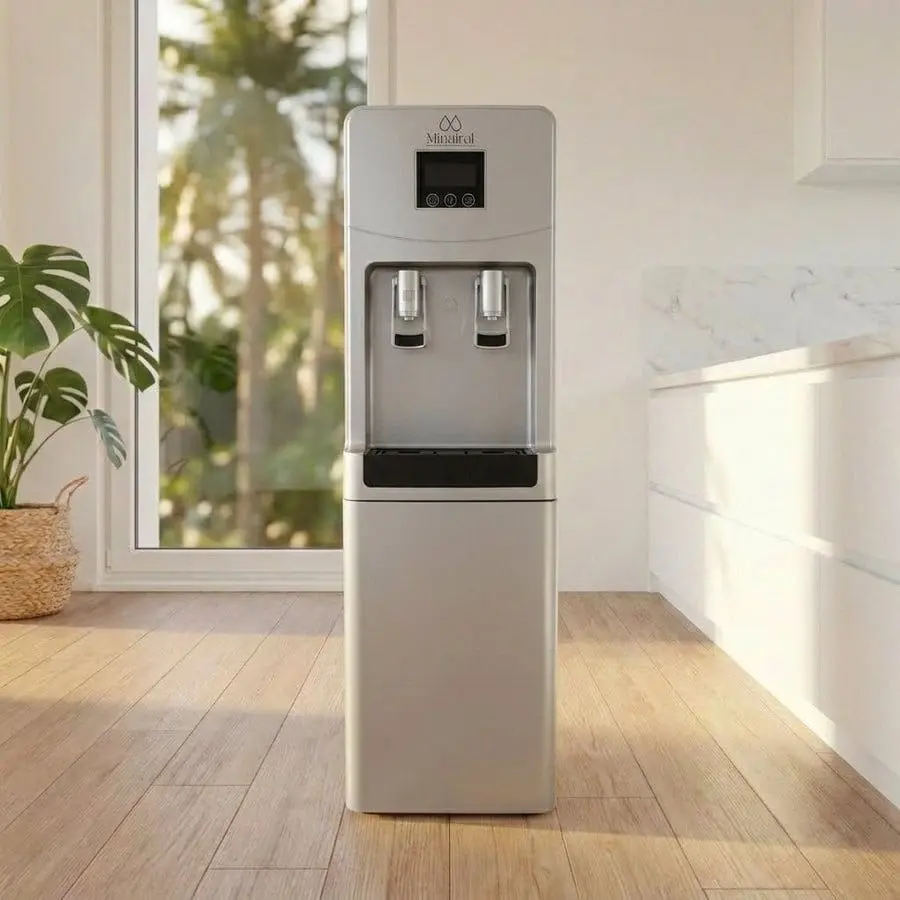
Pure comes in two formats, countertop and floor-standing. Both share the same five-stage reverse osmosis, remineralisation, continuous UV-C and internal recirculation.
| Model | Format | Tanks | Electricity |
|---|---|---|---|
| Pure Countertop, see this model on the online shop | Countertop | 7 L, stainless | About 40 to 50 W while cooling |
| Pure Floor, see this model on the online shop | Floor-standing | 13 L, stainless | About 40 to 50 W while cooling |
The Pure Countertop sits beside a sink or on a counter, with 7 L stainless steel tanks. The Pure Floor is free-standing, with 13 L stainless steel tanks. Both draw only around 40 to 50 W while cooling, a few baht of electricity a month.
Both models share the same treatment: five-stage reverse osmosis, remineralisation, continuous UV-C sterilisation and internal recirculation of the stored water. The choice of format and number of units is made at the site assessment, from the volume and the space at each point of use.
A Pure system connects to the existing water line at the point of use. Machines are checked and configured before delivery, then placed, connected and tested on site, in under an hour. Your team is trained on the machines actually installed, with manuals and quick-start guides, and every installation ends with a report signed by both parties.
On Pure systems the sediment and pre-filter is changed every four months. The post-carbon filter, the mineral filter and the reverse osmosis membrane are replaced every twelve months. TDS and pH are checked during routine maintenance, and water produced on site can be tested once a year by an independent ISO 17025 accredited laboratory as part of the business service plan.
Maintenance is carried out by Minairal technicians from service centres in Koh Samui, Phuket and Hua Hin, with coverage of Bangkok and Koh Phangan. Response time is 4 hours on average, Monday to Saturday, 9:00 to 18:00, in English and Thai.
Pure needs a water connection. Where there is none, or where water must keep flowing when the network does not, an Air system makes water from humidity instead. Both are compared with bottled water in air-to-water vs reverse osmosis vs bottled water. For hotel configurations, see water systems for hotels and resorts, and to count the bottles a site stops buying, use the impact calculator.
For your home: water filters for home use are available on our online shop.
More answers on the FAQ page.
The format and the tanks. The Countertop sits on a counter or beside a sink, with 7 L stainless steel tanks. The Floor is free-standing, with 13 L tanks. Both draw only around 40 to 50 W while cooling, a few baht of electricity a month. The treatment is the same on both: five-stage reverse osmosis, remineralisation, continuous UV-C and internal recirculation.
Under an hour. The system connects to the existing water line, and machines are checked and configured before delivery.
Hot water at 90°C and cold water at 4°C.
The reverse osmosis membrane is rated at 75 GPD, roughly 12 litres an hour, and the systems are sized for around 22 litres of daily use. Output is stable because it does not depend on humidity.
Calcium, magnesium, potassium and sodium, through a mineral filter using Biocera technology. The water has an alkaline pH of 8.5 and above and 40 to 80 ppm of total dissolved solids.
The pre-filter every four months, and the post-carbon filter, mineral filter and reverse osmosis membrane every twelve months. Minairal technicians carry out the replacement.
The price of an RO water filter in Thailand depends on the machine, the installation, the filter changes and whether the water is remineralised. How to compare.
Read the article
RO water explained: what reverse osmosis removes, its real pros and cons in Thailand, why it strips minerals and how remineralisation puts them back.
Read the article
Can you drink boiled tap water in Thailand? Boiling kills bacteria, viruses and parasites but leaves metals, salts and chlorine by-products. What it misses.
Read the articleTell us the points of use, the number of people and the water connection. A site assessment settles the format and the number of units.