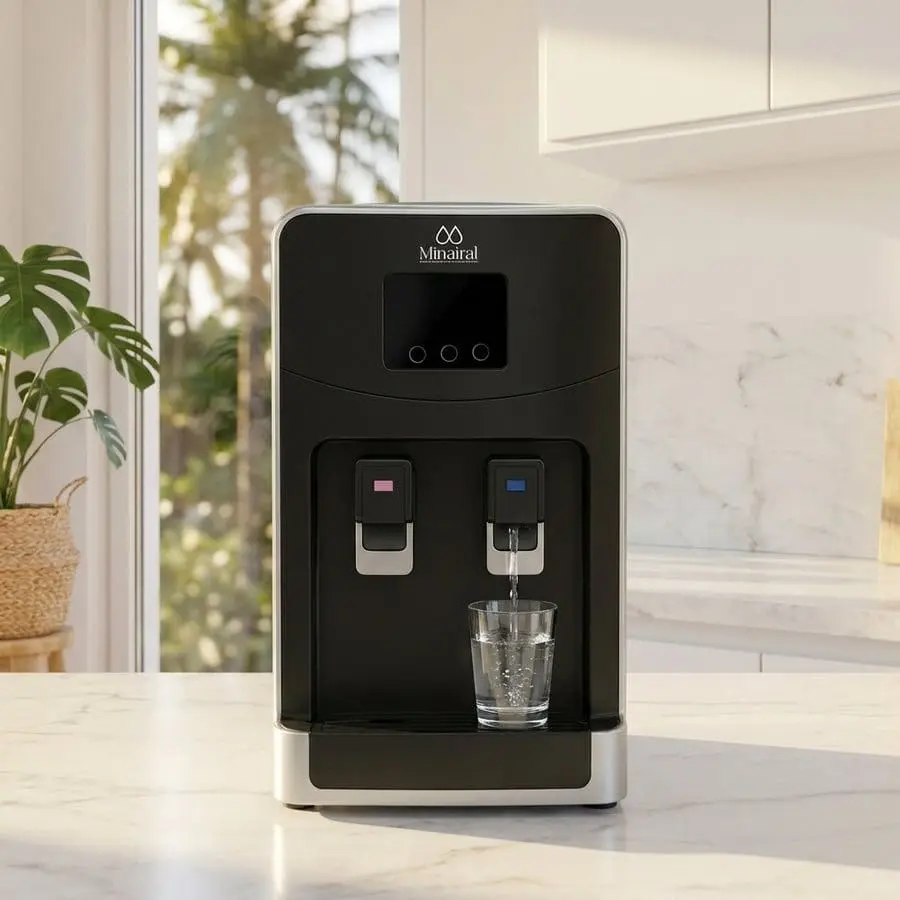
Air Top
- Average daily output*Average 13 L
- DeliveryHot and cold
- Storage7 L
The Air range makes mineral drinking water from the humidity in the air. No inlet and no connection to the network: the unit plugs in, condenses, filters, remineralises and dispenses on site.
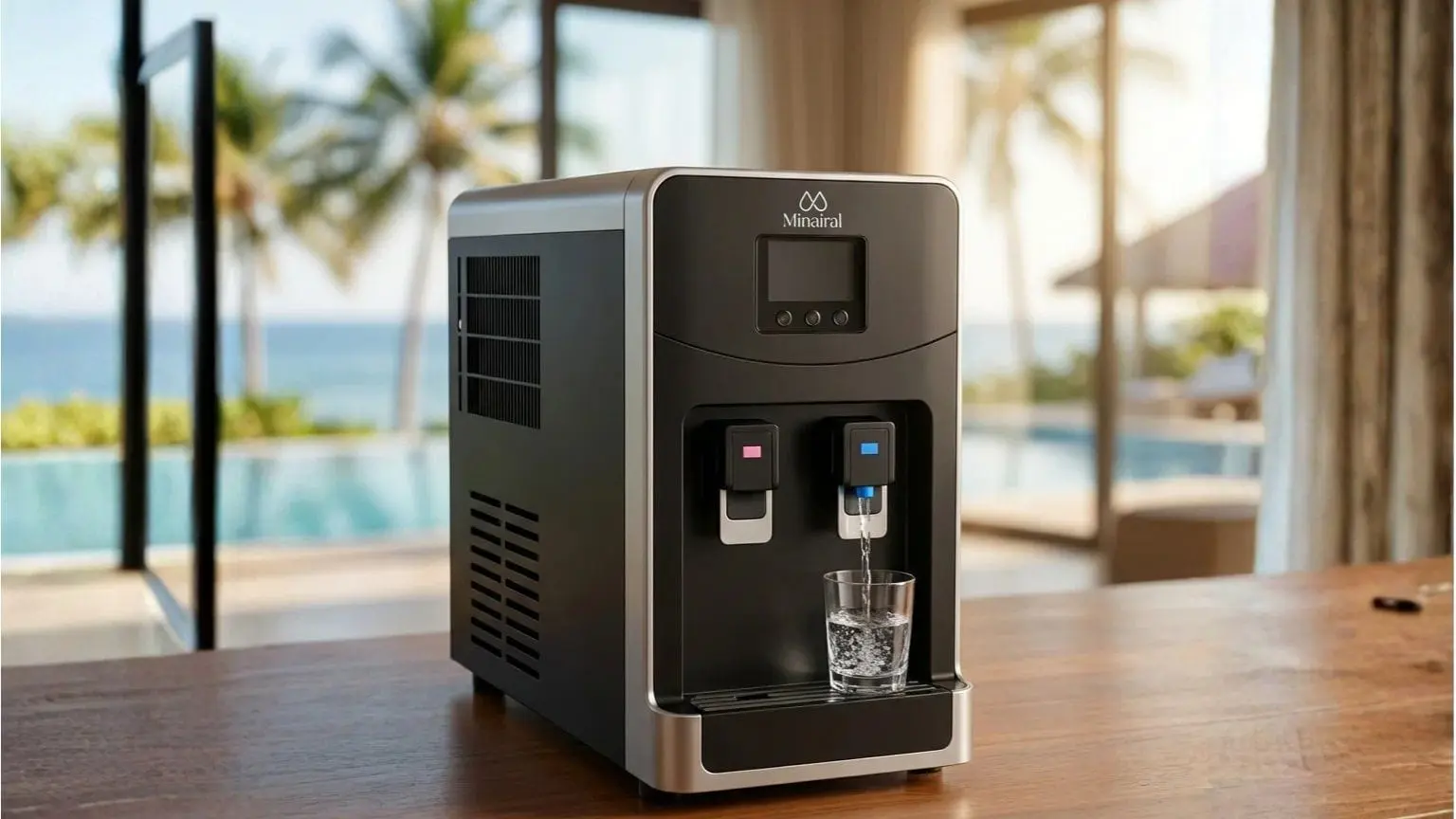
An atmospheric water generator, also called an air-to-water machine, is a unit that produces drinking water from the water vapour already present in the air. It does not draw on a mains connection, a well or a delivery. It needs electricity and humid air.
Minairal Air systems condense that humidity, filter and protect it, then restore calcium, magnesium, potassium and sodium before dispensing. On the Air Stand Pro the treatment runs to seven stages. The result is the same water standard as the rest of the range: filtered, remineralised and alkaline. The full treatment detail is on the water quality page.
Four steps, inside one cabinet. For the physics behind them, read how atmospheric water generators work.
Ambient air is drawn through an air filter before it reaches the condenser.
The air passes over a cold surface. Below its dew point, the water vapour turns to liquid and is collected.
The collected water is filtered and protected with UV. On the Air Stand Pro the sequence runs to seven stages.
Calcium, magnesium, potassium and sodium are restored, then the water is stored and dispensed, cold or hot depending on the model.
Every daily figure on this page is an average daily output, for relative humidity between 30% and 80% and an average temperature of 25°C. The systems operate across that humidity range.
The model and the number of units are chosen at the site assessment, against the volume the site actually needs at each point of use.
From a countertop unit to a floor-standing system producing 30 litres a day on average.
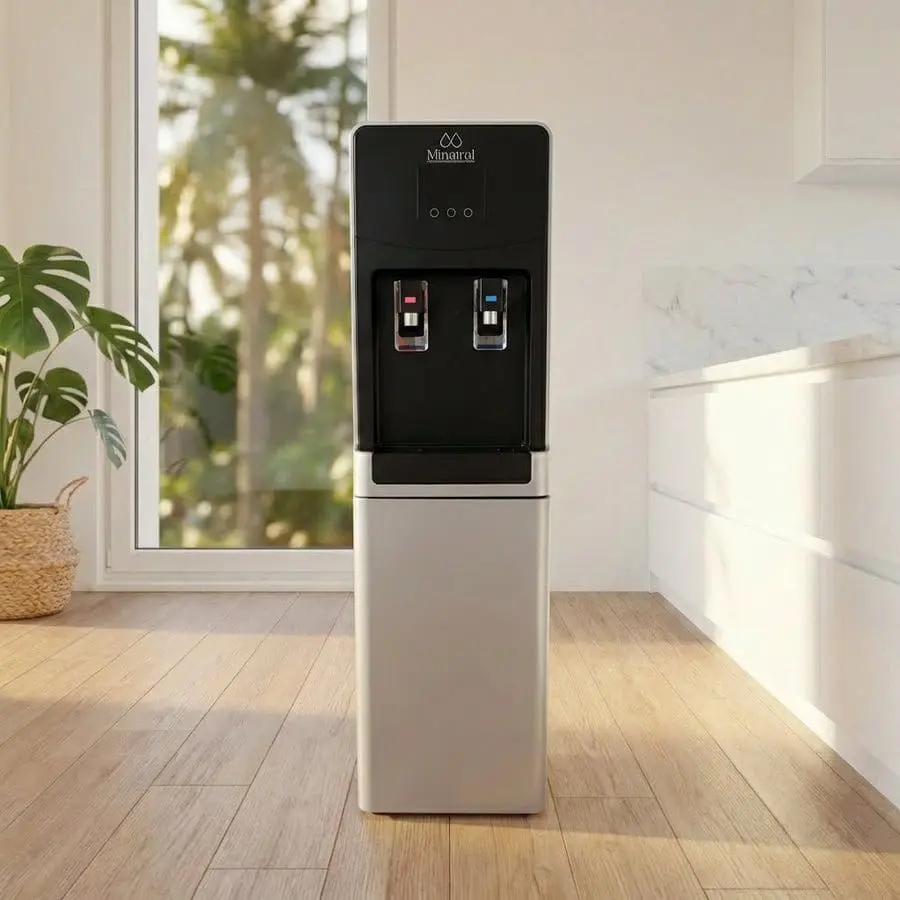
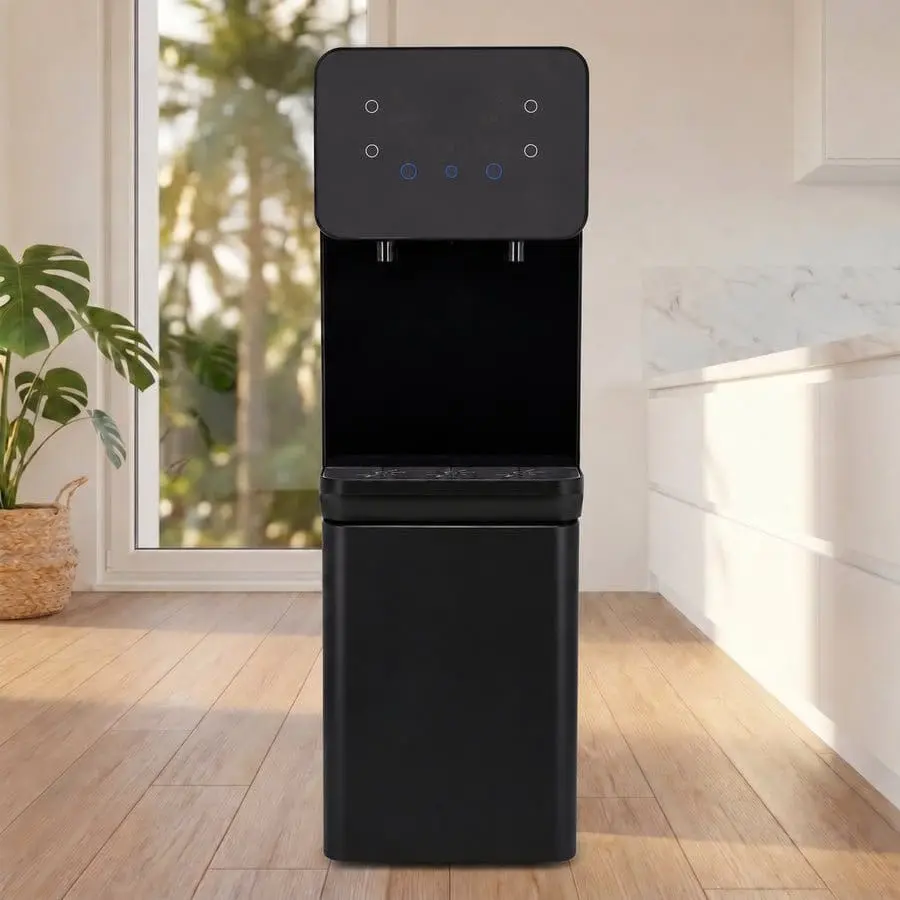
| Model | Average daily output* | Delivery | Storage |
|---|---|---|---|
| Air Top | Average 13 L | Hot and cold | 7 L |
| Air Stand | Average 16 L | Hot and cold | 11 L |
| Air Stand Pro | Average 30 L | Cold | 13.5 L |
The Air Stand Pro runs a seven-stage treatment. The exact configuration for each model is confirmed at the site assessment.
Air systems do not treat mains water. They protect the water they condense with filtration and UV, then remineralise it. On the Air Stand Pro the sequence runs to seven stages.
Filters the incoming air before condensation.
Removes particles from the condensed water.
Carbon filtration ahead of the membrane.
Filtration at 0.0001 micron.
Final polishing for taste and smell.
Ultraviolet protection on the water line.
UV protection for the stored water.
Calcium, magnesium, potassium and sodium are restored by a mineral filter using Biocera technology, for an alkaline pH of 8.5 and above and 40 to 80 ppm of total dissolved solids.
Anywhere the water connection is missing, unreliable or not fit to drink, and every bottle has to be shipped in.
On an island every litre of bottled water arrives by boat and then truck. An Air system takes that delivery off the site entirely.
No inlet is needed, so the supply exists whether the mains does or not, including during pressure loss at peak demand.
Rooms, lobbies, restaurants and bars, with optional branded glass bottles. See water systems for hotels and resorts.
One system per villa, serviced across a managed portfolio.
Hydration for guests and members, across treatments and facilities.
Free-flow stations for teams and students, with no deliveries to manage.
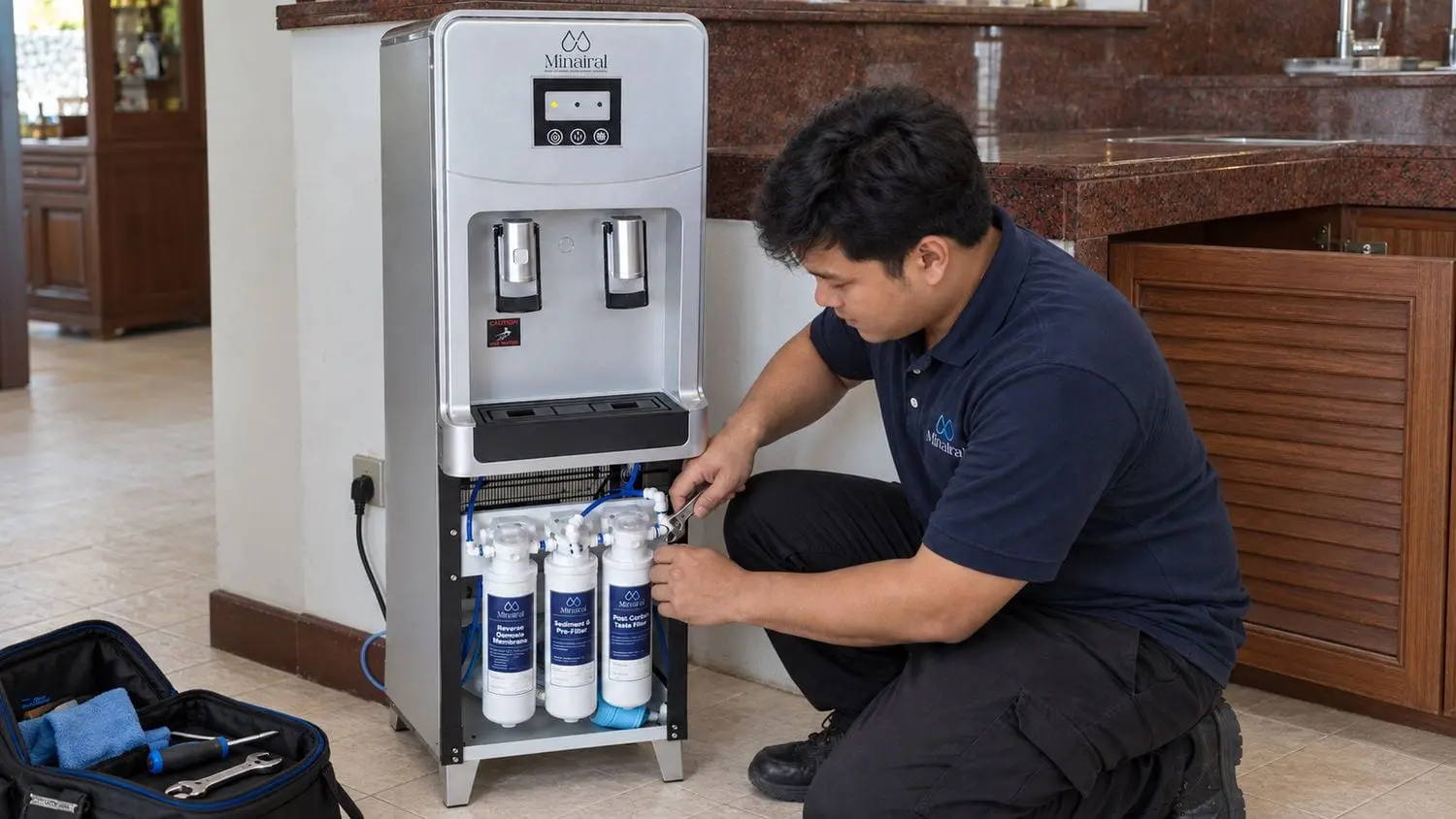
On Air systems the sediment and pre-filter is changed every six months. The post-carbon filter, the mineral filter and the reverse osmosis membrane are replaced every twelve months. TDS and pH are checked during routine maintenance.
Maintenance is carried out by Minairal technicians, two to five per service centre, from Koh Samui, Phuket and Hua Hin, with coverage of Bangkok and Koh Phangan. Several hundred spare parts are held in country. Response is same day in most cases and 48 hours at the latest, Monday to Saturday, in English and Thai.
If the site has a reliable water line and needs a stable daily volume, a Pure reverse osmosis system may fit better. The two technologies are compared side by side, with bottled water, in air-to-water vs reverse osmosis vs bottled water. To see how many bottles a site stops buying, use the impact calculator.
For your home: air-to-water machines for home use are available on our online shop.
More answers on the FAQ page.
It draws humid air through a filter, cools it below its dew point so the water vapour condenses, then treats the water with filtration and UV and restores minerals. On the Air Stand Pro the sequence runs to seven stages: air filter, sediment, pre-carbon, reverse osmosis, post-carbon, LED UV and a UV lamp in the tank.
13 L a day on average for the Air Top, 16 L for the Air Stand and 30 L for the Air Stand Pro. These are average daily outputs, for relative humidity between 30% and 80% and an average temperature of 25°C.
The systems operate for relative humidity between 30% and 80%. The model and the number of units are sized at the site assessment against the volume the site needs.
No. It plugs into a power socket. There is no inlet and no connection to the water network.
The Air Top and Air Stand deliver hot and cold water. The Air Stand Pro delivers cold water.
The pre-filter is replaced every six months, and the post-carbon filter, mineral filter and reverse osmosis membrane every twelve months. Minairal technicians carry out the maintenance from service centres in Koh Samui, Phuket and Hua Hin.
Tell us the location, the number of people and the points of use. A site assessment settles the model and the number of units.