Air-to-water vs reverse osmosis vs bottled water.
Three ways to supply drinking water to a hotel, a restaurant, an office or a school in Thailand. What each depends on, what it costs the site in deliveries and plastic, and how to choose.
Three options, three different sources.
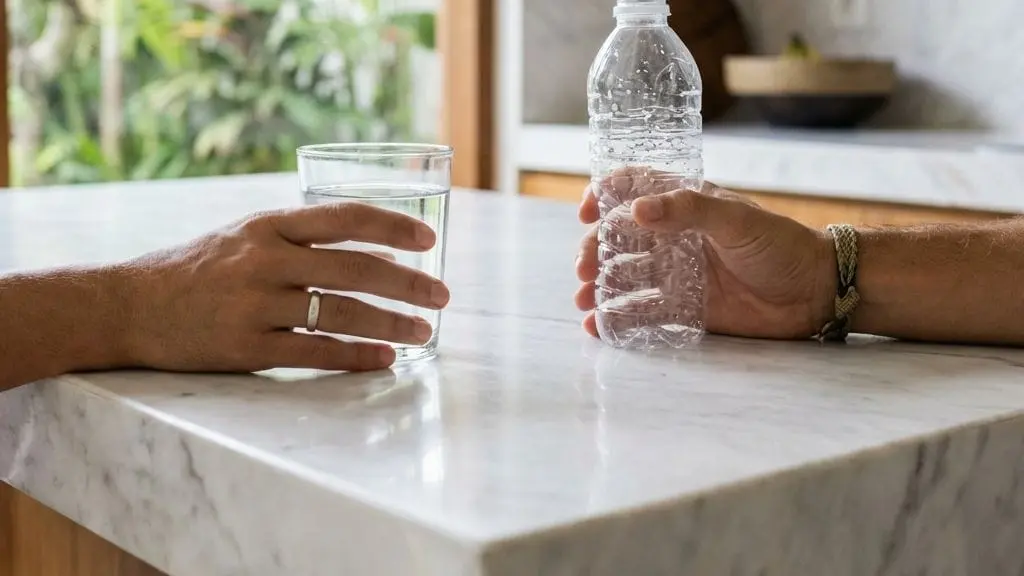
An atmospheric water generator makes drinking water from the humidity in the air. A reverse osmosis system filters the water already arriving through the site's water line. Bottled water is produced elsewhere and delivered.
Minairal designs, installs and services the first two, under the names Air and Pure. Both end the same way: filtered water, remineralised with calcium, magnesium, potassium and sodium, at an alkaline pH. What separates them is where the water starts. Bottled water is included here because it is what most sites use today.
Side by side.
The criteria a site assessment looks at, for each option.
| Criterion | Air-to-water (Air) | Reverse osmosis (Pure) | Bottled water |
|---|---|---|---|
| Water source | Humidity in the ambient air | The existing water line | A bottling plant off site |
| Dependence on the mains | None. No inlet, no connection to the network | Needs a water connection | None on site, but depends on the supply chain |
| Output | 13 L, 16 L or 30 L a day on average per unit, for relative humidity between 30% and 80% and an average temperature of 25°C | Stable, from the water line. Membrane rated at 75 GPD, roughly 12 L an hour, sized for around 22 L of daily use | Whatever is ordered and stored |
| Deliveries | None | None | Recurring, by truck, and by boat to the islands |
| Single-use plastic | None | None | 1,460 half-litre bottles per person a year, at two litres a day |
| Treatment | Filtration and UV, seven stages on the Air Stand Pro, then remineralisation | Five-stage reverse osmosis at 0.0001 micron, remineralisation, continuous UV-C | Depends on the bottler and on how the bottle was stored |
| Delivery | Hot and cold on the Air Top and Air Stand, cold on the Air Stand Pro | Hot 90°C and cold 4°C | Ambient, or chilled on site |
| Installation | Plug in, no plumbing | Under an hour on the existing line | Storage space for stock |
| Upkeep | Pre-filter every 6 months, other cartridges every 12 months, by Minairal technicians | Pre-filter every 4 months, other cartridges every 12 months, by Minairal technicians | Ordering, receiving, storing, chilling and disposing of bottles |
| Continuity | Water keeps flowing when the network does not | Follows the water line | Stops when deliveries or stock run out |
What bottled water adds up to.
At two litres a day from half-litre bottles, one person uses 1,460 bottles a year, or 730 litres. A site of fifty people reaches 73,000 bottles a year. Multiply by the years the system runs.
The cost is not only plastic. It is bottling, the boat and truck freight to an island, refrigeration on the way, storage on site and disposal afterwards. Every litre produced on site is a litre that was never bottled, never shipped and never collected. Put your own numbers in the impact calculator, or read the assumptions on the sustainability page.
When to choose which.
The decision is made at the site assessment, on four questions.
Water connection
Does one exist, and how reliable is it? With no connection, or one that fails at peak demand, Air is the option that does not depend on it. With a reliable line, Pure uses it.
Volume
How many litres a day, at which points? Pure output is stable from the water line. Air output is an average of 13 L, 16 L or 30 L a day by model, so the model and the number of units are sized against the site.
Space
Countertop, floor, or several points of use? Both ranges come in countertop and floor-standing formats.
Continuity
Must water keep flowing when the network does not? Air systems have no inlet, so the supply exists whether the mains does or not.
A site can combine both: Air where there is no reliable connection, Pure where a water line is available. The luxury tented resort on the projects page runs Air and Pure at multiple points. For hotel configurations, see water systems for hotels and resorts.
The water itself.
Both on-site options deliver the same water standard: an alkaline pH of 8.5 and above, 40 to 80 ppm of total dissolved solids, and four minerals restored. TDS and pH are checked during routine maintenance, and water produced on site can be tested once a year by an independent ISO 17025 accredited laboratory as part of the business service plan. The full sequence is on the water quality page.
With bottled water, quality depends on the bottler and on how the bottle was stored on its way to the site.
Questions about the three options.
More answers on the FAQ page.
Is an air-to-water machine better than a reverse osmosis system?
Neither is better in general. An air-to-water machine needs no water connection and keeps working when the network does not. A reverse osmosis system gives a stable output from an existing water line. The choice depends on the connection, the volume, the space and the need for continuity.
How many plastic bottles does one person use in a year?
At two litres a day from half-litre bottles, 1,460 bottles a year. On a site of fifty people, that is 73,000 bottles a year.
Does reverse osmosis remove minerals from water?
Yes. That is why Minairal systems restore calcium, magnesium, potassium and sodium after filtration, through a mineral filter using Biocera technology.
Can a site use both Air and Pure systems?
Yes. A site can use Air where there is no reliable water connection and Pure where a water line is available. The mix is set at the site assessment.
What maintenance do on-site systems need compared with bottled water?
On-site systems need the pre-filter replaced every four to six months depending on the system, and the other cartridges every twelve months, carried out by Minairal technicians. Bottled water needs ordering, receiving, storage, chilling and disposal for as long as the site buys it.
Not sure which option fits? It is decided on site.
A site assessment settles the technology, the model and the number of points of use, before any commitment.