A commercial atmospheric water generator is not one large machine. For a hotel, an office or a school it is a set of units of the right size, placed where people actually drink, and sized against a number that can be checked: litres a day. This article shows the calculation Minairal uses at a site assessment, with three worked examples, so that you can run your own figures before we visit.
In short: count the people on site, multiply by two litres a day, and divide by the average daily output of the unit. An Air Stand Pro produces 22 litres a day on average (up to 30 litres), so a 50-room hotel with 100 guests needs about 200 litres and ten units, usually spread across pantries, lobby, pool and restaurants, often alongside Pure systems on the water line.
What counts as a commercial atmospheric water generator?
In Minairal's range the commercial workhorse is the Air Stand Pro: floor-standing, cold water only, seven treatment stages, a 13.5-litre tank and 22 litres a day on average, up to 30 litres. The Air Stand (16 litres a day on average, hot and cold) and the Air Top (13 litres, hot and cold, countertop) cover points of use where hot water matters or space is tight. All figures are averages for relative humidity between 30% and 80% and an average temperature of 25°C. Specifications are on the Air range page. What the machines cost, and what the figure includes, is covered in our air water generator price guide for Thailand.
Where a reliable water line runs, a Pure reverse osmosis system, sized for around 22 litres of daily use with hot at 90°C and cold at 4°C, often takes part of the load. Most commercial sites end up with both: Air where there is no line or where water must keep flowing when the mains stops, Pure in kitchens and pantries.
How do you calculate the number of units?
Three steps, the same for every sector.
- People on site per day. Guests, staff, pupils, visitors: whoever drinks from the system on a typical day.
- Litres a day. Multiply by 2 litres per person. It is the method used across this site and in the impact calculator, generous for adults and an upper bound for children.
- Units. Divide by the average daily output of the model, and round up. Then distribute the units across the points of use, because a lobby, a pool deck and a staff kitchen cannot share one machine.
The third step is where the site assessment earns its place. The total tells you how many litres; the layout tells you how many units and where.
Worked example 1: a 50-room hotel
Assume 100 guests on site each day, two per room, staff not counted.
| Step | Calculation | Result |
|---|---|---|
| Daily volume | 100 × 2 L | 200 L a day |
| All Air Stand Pro | 200 ÷ 22, rounded up | 10 units |
| Yearly volume | 200 L × 365 | 73,000 L a year |
| Bottles replaced | 73,000 ÷ 0.5 L | 146,000 half-litre bottles a year |
Ten units in one room would be absurd, so the plan follows the property. A typical distribution for this hotel:
| Point of use | System | Litres a day |
|---|---|---|
| Housekeeping pantries, filling 500 mL glass bottles for rooms | 4 × Pure Floor on the line | About 88 L |
| Lobby free-flow station | 1 × Air Stand Pro | 22 L |
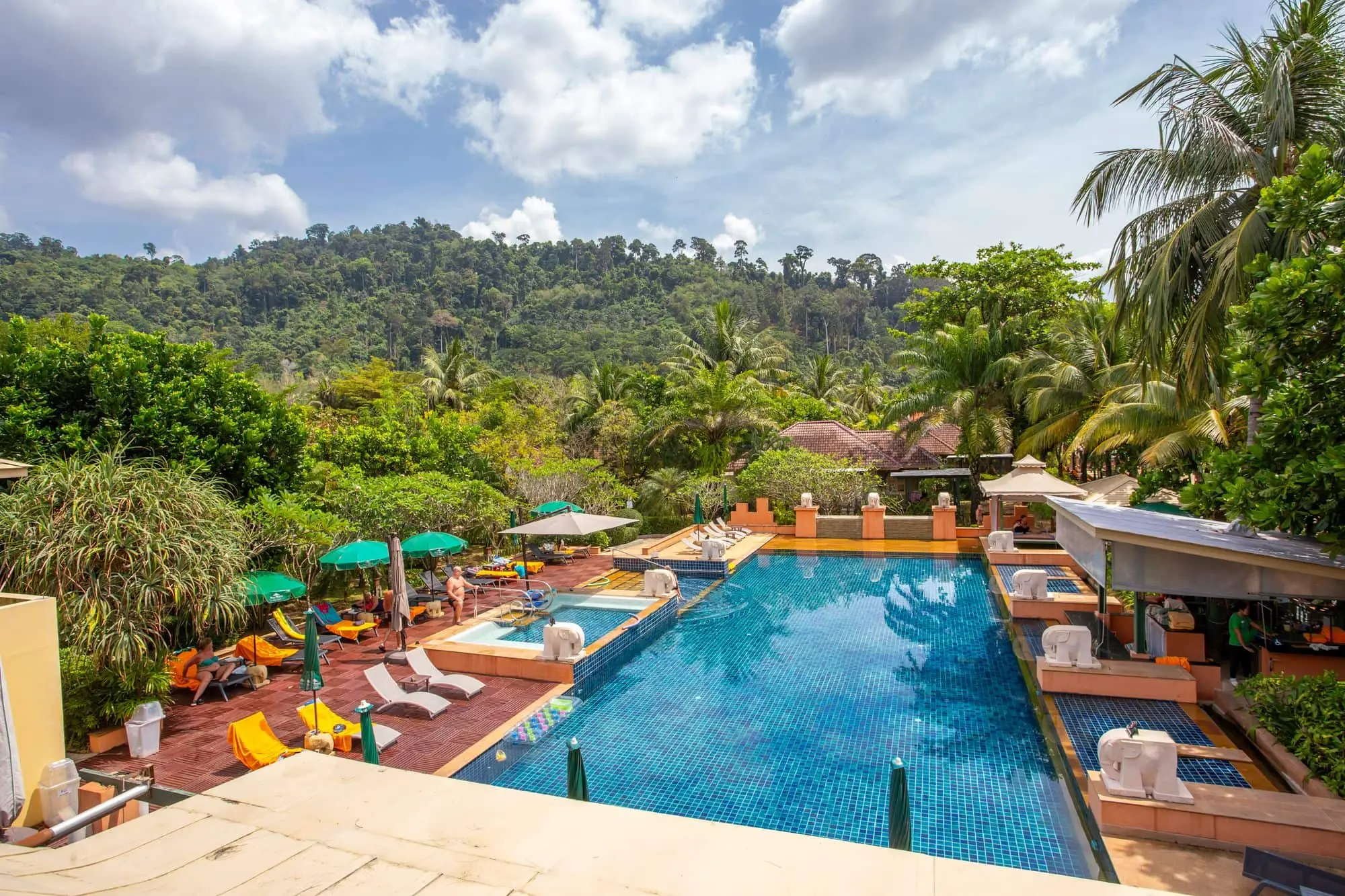
| Pool deck and beach bar, no plumbing | 3 × Air Stand Pro | 66 L |
| Restaurant and kitchen | 1 × Pure Floor | 22 L |
| Staff areas | 1 × Pure Floor | 22 L |
| Total | 10 units | About 220 L |
Villas or tented rooms away from the main building get their own Air unit each. The full hotel configuration is on drinking water systems for hotels and resorts.
Worked example 2: a 50-person office
An office is open about 260 days a year, so the yearly figure is lower, but the daily sizing is the same: 50 × 2 L = 100 litres a day. Offices also want hot water for tea and coffee, which the Air Stand Pro does not deliver.
| Option | Units | Litres a day | Notes |
|---|---|---|---|
| Pantry line available | 5 × Pure (floor or countertop) | About 110 L | Hot 90°C and cold 4°C, one per floor or wing |
| No line, or plumbing not allowed | 3 × Air Stand Pro + 2 × Air Stand | 98 L, close to the 100 L target | Air Stand gives hot and cold in the main pantry; add an Air Top if the margin matters |
| Mixed | 2 × Pure Floor + 3 × Air Stand Pro | About 110 L | Pure in the pantry, Air on floors with no line |
At 19 litres per gallon, this office stops ordering about 1,921 gallons a year counted over 365 days, or 1,368 over 260 working days. See office drinking water systems.
Worked example 3: a school of 150 pupils and staff
Schools are the sector where the two-litre rule is clearly an upper bound: young children drink less, and the school year runs about 200 days. The assessment therefore starts from the upper bound and scales it to the calendar and the age groups.
| Step | Calculation | Result |
|---|---|---|
| Upper-bound volume | 150 × 2 L | 300 L a day |
| All Air Stand Pro | 300 ÷ 22, rounded up | 14 units |
| Over 200 school days | 300 L × 200 | 60,000 L a year, or 3,158 gallons of 19 L |
In practice the Air Stand Pro, cold water only, goes where pupils gather, in corridors and covered play areas, where a hot tap would be unwelcome and where there is often no plumbing. Pure systems serve classrooms with a line, the staff room with hot water and the canteen. For a school the deciding factor is the break-time peak: many pupils filling bottles in ten minutes, which favours several units with their own tanks over fewer larger ones. The configuration is on drinking water stations for schools.
What else changes the count?
- The room. Air systems operate between 30% and 80% relative humidity, and an air-conditioned sealed room is drier than a lobby with open doors. The assessment checks each room where a unit will stand.
- Peaks. The daily output is produced over 24 hours and stored in the tank. A site where everyone drinks at once needs more tanks, not just more litres.
- Hot water. Only the Air Top, Air Stand and Pure range deliver hot water. Where tea and coffee are made, the mix changes.
- The water line. Where it is reliable, Pure takes a share of the volume at a stable output. Where it is not, or where water must keep flowing during a cut, Air carries it.
- Power. Each Air unit needs its own socket and draws between 370 and 500 W while running. A Pure system draws around 40 to 50 W while cooling, a few baht a month.
- Service. Pre-filters are replaced every four to six months depending on the system, other cartridges every twelve months. Minairal technicians work from Koh Samui, Phuket and Hua Hin, with coverage of Bangkok and Koh Phangan, and respond the same day in most cases, 48 hours at the latest.
What a site stops buying once the units run, and the logistics it removes, are set out in on-site water generation: reduce deliveries.
Frequently asked questions
How many atmospheric water generators does a hotel need?
Count the guests, multiply by two litres a day and divide by 22 litres per Air Stand Pro. A 50-room hotel with 100 guests needs about 200 litres a day, so around ten units, usually a mix of Air at the pool and lobby and Pure in the pantries and kitchen.
Can one unit serve a whole office floor?
An Air Stand Pro covers about eleven people at two litres each. A floor of 30 people needs three units, or Pure systems on the pantry line sized for around 22 litres of daily use each.
Which Minairal atmospheric water generator has the highest output?
The Air Stand Pro, at 22 litres a day on average and up to 30 litres, with a 13.5-litre tank and seven treatment stages. Larger sites use several units rather than one larger machine, so that the water is where people are.
Do you size the system for us?
Yes. Request a site assessment with the number of people, the buildings, the points of use and where the water lines run. You receive a configuration, a capacity and a maintenance plan written for the site.