To choose an RO water purifier in Thailand, check eight things in this order: the water coming into your building, the number and type of stages, the daily output you need, tank or direct flow, whether minerals are added back, UV protection, filter cost and interval, and who services it. The brand matters less than these eight points, because most RO membranes are made by a handful of manufacturers and the differences lie in what sits around them.
This guide is for a home, a condo, a café or an office that wants to stop buying bottled water. It does not rank brands. It gives you the questions to ask any seller, including us.
Check 1: what is in your water now?
Reverse osmosis removes dissolved solids, so the first question is how many you have. Tap water in Bangkok and most PWA towns is treated and moderately mineralised; well water on islands and in villas can be hard, salty or carry iron. A TDS meter costing a few hundred baht gives you the starting number in ten seconds.
If your TDS is under about 150 mg/L and the water is municipal, a good carbon and ultrafiltration unit may be enough for taste and microbes. Above that, or with any private source, RO is the right tool. Share the reading with the seller; a serious one will ask for it.
Check 2: how many stages, and which ones?
A five-stage system is the standard that works: a sediment pre-filter, two carbon stages to protect the membrane from chlorine, the RO membrane itself, and a post-filter for taste. Extra stages are sold as upgrades, but a stage only adds value if it does something the others do not, such as remineralisation or UV.
- Sediment pre-filter. Catches sand and rust. It takes the hit for everything downstream, which is why it is changed most often.
- Carbon. Removes chlorine, which damages RO membranes, and improves taste.
- RO membrane. The stage that removes dissolved solids, heavy metals, nitrate and microbes.
- Post-filter and optional stages. Taste polishing, mineral addition, UV.
Check 3: how many litres a day do you need?
RO membranes are rated in gallons per day (GPD) at ideal pressure. Real output in a Thai building is lower because mains pressure is often weak and the water is warm. Count about 2 litres per person per day at home and 1.5 litres per person per working day in an office, then add coffee, tea and cooking. A 50 GPD membrane makes about 190 litres a day on paper and less in practice; a family of four is well within that, a 30-person office is not.
Check 4: tank or direct flow?
Traditional RO units fill a pressurised tank slowly and serve from it. Direct-flow units use a larger membrane and a pump to deliver water on demand. Each has a place.
| Tank system | Direct flow | |
|---|---|---|
| Space | Needs room for a 10 to 12 litre tank | Compact, countertop or under-sink |
| Flow | Fast until the tank empties, then a wait | Steady, limited by the membrane |
| Hygiene | Tank must be sanitised at service | No stored water |
| Power | Often none | Pump, plus heating and cooling if fitted |
| Best for | Low mains pressure, intermittent use | Offices, cafés, hot and cold dispensing |
Check 5: does it add minerals back?
RO water leaves the membrane with almost nothing dissolved in it, which tastes flat and is slightly acidic. A remineralisation stage passes the water over calcium and magnesium media so that it tastes like water again and has a neutral pH. Most Thai buyers prefer it, and it is the main reason some people say they do not like RO water. We explain the trade-offs in RO water: pros, cons and why remineralisation matters.
Check 6: is there UV protection?
The membrane itself blocks bacteria, but water can pick up microbes after it, in a tank, a tap or a hot and cold dispenser that stands in a warm room. A UV-C lamp at the outlet keeps the water protected to the glass. It matters most where many people use one machine, such as an office or a café, and where the unit may sit unused over a long weekend.
Check 7: what do the filters cost and how often do they change?
The purchase price is only part of the cost. Ask for the filter schedule and the price of each cartridge before you sign. A typical rhythm is the pre-filter every four months, the carbon and post-filters every twelve months and the membrane every two to three years, depending on your water. Multiply by the cartridge prices and you have the real annual cost. Our article on RO water filter prices in Thailand breaks down what drives the figures.
Check 8: who installs it and who comes when it fails?
An RO unit is plumbing. It needs a clean installation, a drain for the reject water, a check of mains pressure and someone to come back when a pump fails or a fitting drips. Ask three questions: who installs, how far away the nearest technician is, and whether filter changes are included or left to you. For a business, a rental with service included is often simpler than buying; our rental page explains how that works.
Which RO purifier should you buy, then?
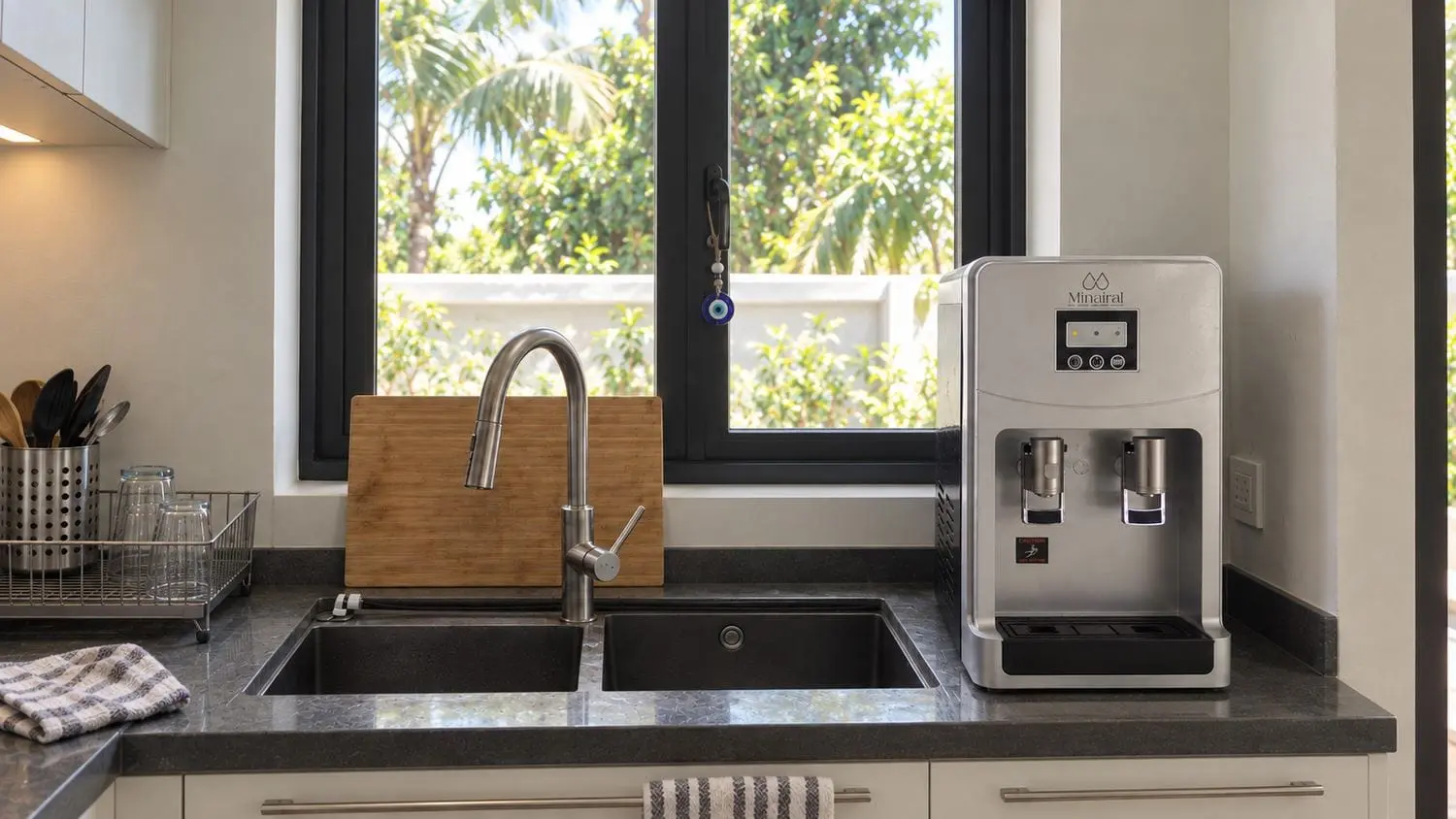
For a home or a condo in a city with municipal water, a five-stage countertop or under-sink unit with remineralisation is enough. For an office, a café or a villa, choose direct flow with hot and cold, UV at the outlet and a service contract. This is how our Pure range is built: five-stage RO, remineralisation, UV-C, hot and cold, installed on the existing water line in under an hour, with the pre-filter changed every four months by our technicians. If your building has no reliable water line at all, an atmospheric water generator is the other route, and we will tell you which one fits.
Frequently asked questions.
Is RO water good to drink every day?
Yes. Reverse osmosis is used for bottled water production worldwide. Choose a unit that adds minerals back so that the water tastes right and has a neutral pH.
How many stages should an RO purifier have?
Five stages cover what matters: sediment, two carbon stages, the membrane and a post-filter. Count remineralisation and UV as useful extras, not as proof of quality.
How much water does an RO system waste?
Older units send two to four litres to the drain for every litre produced. Modern direct-flow units with a pump do much better. Ask for the recovery ratio, and route the reject water to plants or cleaning if you can.
Does an RO purifier work with low water pressure?
A tank system runs on mains pressure and slows down below about 2 bar. A direct-flow unit has its own pump and copes with the weak pressure common in Thai buildings and on upper floors.
Which RO brand is best in Thailand?
No single brand wins. Judge the eight checks above, the filter cost and the service network near you, and ask to see an installed unit before you buy.
For a home or a condo, the Pure models and their filters are on our online shop. For an office, a café or a hotel, book a site assessment and we will measure your water and recommend a system without obligation.