A hot and cold water dispenser in Thailand comes in three types: a top-load dispenser fed by a 19 L bottle, a bottom-load dispenser with the bottle hidden in a cabinet, and a point-of-use dispenser that makes its own water from the water line or from the air. All three deliver hot and cold water. They differ in what you carry, what you clean, what you throw away and what you pay per litre. For most homes and businesses, the point-of-use type removes bottles, deliveries and lifting for good.
What is a hot and cold water dispenser?
A hot and cold water dispenser is a machine with a small heater and a small refrigeration circuit that stores water in two internal tanks, one at around 90°C for tea and instant coffee, the other chilled at around 4°C. Two taps on the front serve either. The question is where the water comes from before it reaches those tanks.
In Thailand the water source has always been a 19 L bottle, because mains water is not meant to be drunk. That is changing as filtration and air-to-water systems replace the bottle at the point of use. The three options below cover the market without naming brands, because the type matters far more than the badge.
Top-load bottle dispensers.
The familiar office cooler. A 19 L bottle is lifted and inverted onto a spike at the top of the machine, and gravity feeds the two tanks. It is the cheapest machine to buy and the simplest to understand.
Its weaknesses are practical. A full bottle weighs about 19 kg, so someone has to lift it above shoulder height each time, which is why so many offices have one person who always does it and one who never will. The open neck collects dust and hands, the reservoir is rarely cleaned, and empty bottles pile up in a corner waiting for the next delivery.
Bottom-load water dispensers.
A bottom-load dispenser hides the bottle in a cabinet under the taps and pumps the water upwards. There is no lifting, the bottle is out of sight, and the machine looks tidier in a reception or a meeting room. This is the type most people search for when they type "water dispenser bottom load".
It remains a bottle dispenser. The same 19 L bottles arrive on the same truck, take the same storage space and go back the same way. The pump and its tube run through every bottle and are a cleaning point most owners forget. The convenience is real, but the supply chain behind it has not changed.
Point-of-use dispensers: water line or air.
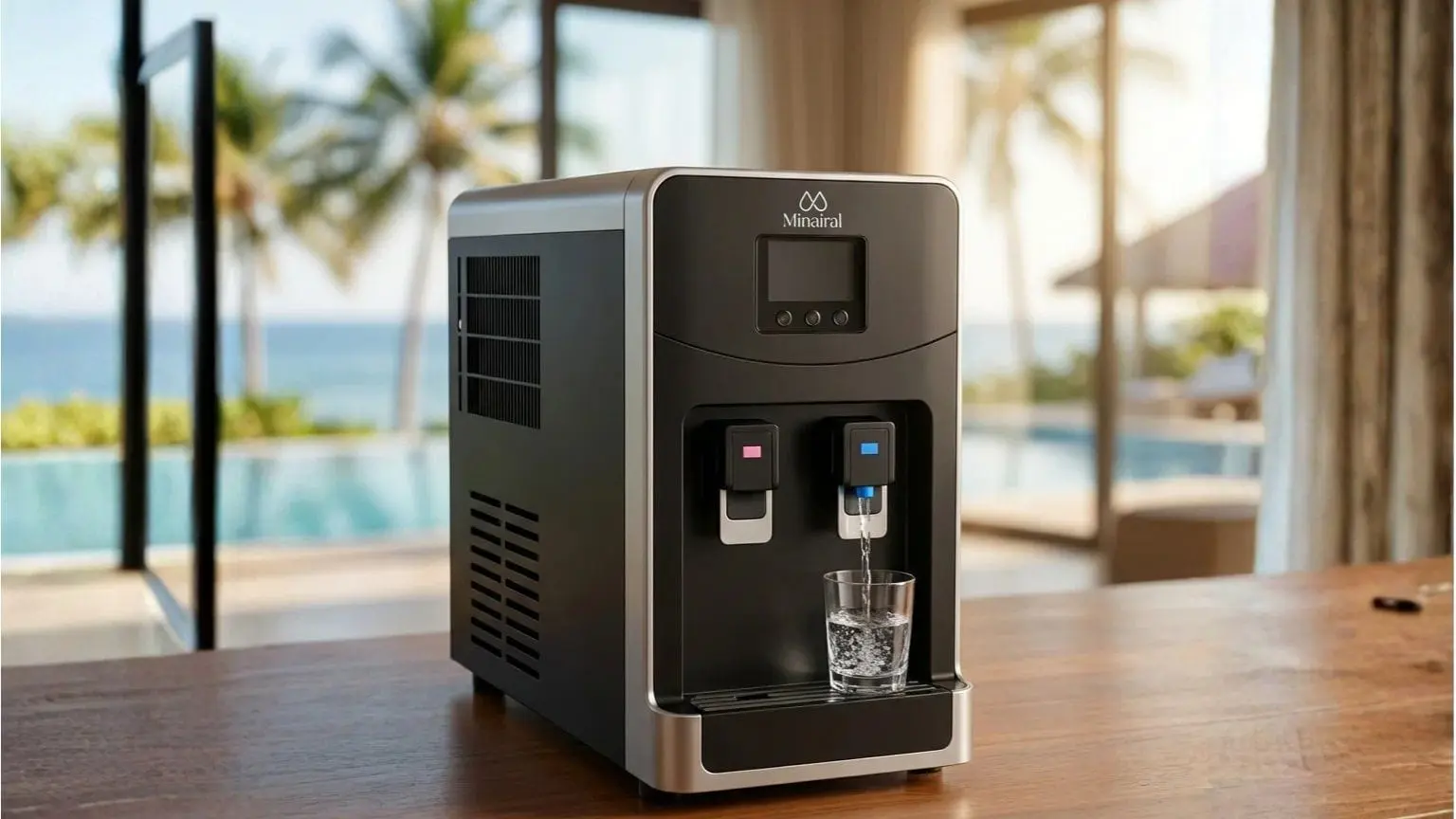
A point-of-use dispenser has no bottle at all. It either filters the existing water line or condenses drinking water from the humidity in the air, then stores it chilled and heated like any other dispenser. Minairal's two ranges cover both cases.
The Pure range connects to the water line with a small hose, treats the water through five-stage reverse osmosis, remineralises it and serves it hot and cold. It draws about 40 to 50 W while cooling, a few baht a month, and is installed in under an hour. The Air range needs no plumbing: the Air Top makes 13 L a day on average, the Air Stand 16 L and the Air Stand Pro 22 L, from the air in the room. Both ranges add calcium, magnesium, potassium and sodium, so the water tastes like mineral water rather than like a filter.
Which water dispenser is easier to keep clean?
The hygiene of a dispenser depends on three things: whether air enters the water, how the stored water is treated, and who cleans the machine. On both bottle types, air enters every time the bottle gurgles, and the reservoir is cleaned only when someone remembers. On a point-of-use system, the water is produced inside a closed circuit.
Minairal systems keep the stored water under continuous UV sterilisation in stainless steel tanks, and a technician changes the filters on schedule: the pre-filter every 6 months on Air and every 4 months on Pure, the other cartridges every 12 months. Nothing is left to the person who happens to walk past. Our water quality page explains what is removed and what is put back.
What do 19 L bottles really cost?
Take your last invoice and divide the delivered price of a bottle by 19 to get the price per litre. Then add the parts that never appear on the invoice: the deposit on the bottles, the storage space for full and empty ones, the staff time for lifting and ordering, and the days when the delivery does not come.
| Top-load bottle | Bottom-load bottle | Point-of-use (Air or Pure) | |
|---|---|---|---|
| Water source | 19 L bottle, delivered | 19 L bottle, delivered | Water line or the air |
| Lifting | 19 kg above the shoulder | None | None |
| Plastic | Bottles in rotation | Bottles in rotation | None |
| Deliveries | Weekly or more | Weekly or more | None |
| Running cost | Per bottle | Per bottle | Filters and a few baht of electricity |
| Hygiene | Open neck, manual cleaning | Pump and tube, manual cleaning | Closed circuit, UV, serviced |
A 30-person office drinking 1.5 litres a head on working days gets through about 50 bottles a month. The same office served by a point-of-use dispenser has no bottles to count. We looked at the office case in detail in our article on bottleless office water dispensers.
Common water dispenser issues.
- Water tastes of plastic. Usual on bottle dispensers left in the sun or stored too long. A point-of-use system makes water as it is drunk.
- Hot water not hot enough. A small heater struggles when many people draw at once. Check the hot tank size against the number of users.
- Dripping taps or a wet floor. Worn seals or a cracked bottle neck. On a serviced system the technician replaces parts on the maintenance visit.
- Green or slimy reservoir. Light and warmth in an open reservoir. Closed stainless tanks under UV do not have this problem.
Frequently asked questions.
Which hot and cold water dispenser is right for a home?
A countertop point-of-use model. The Pure Countertop on the water line or the Air Top from the air both serve hot and cold water with no bottle to buy. Both are on our online shop.
Can a dispenser work without a water line?
Yes. The Air range makes drinking water from the humidity in the air and only needs a power socket. It suits condominiums, villas and rooms far from any pipe.
How much does a hot and cold water dispenser cost in Thailand?
Bottle dispensers are cheap to buy and expensive to feed. Point-of-use systems cost more upfront and then only the filters. Residential prices are on the shop; for a business, pricing follows a site assessment through our contact page.