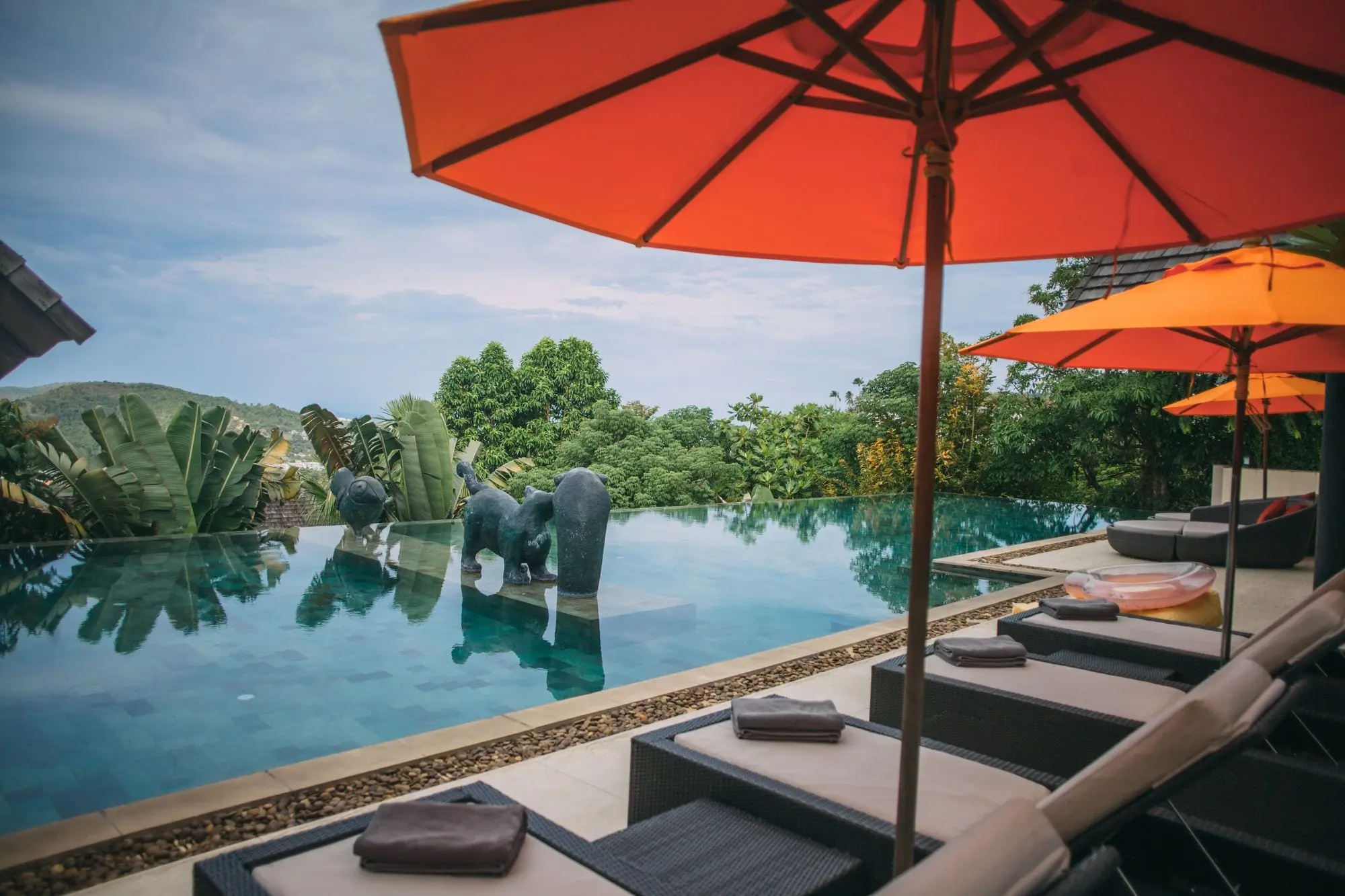
A villa in Thailand is a small hotel without a back of house. Guests arrive every few days, the kitchen must be ready from the first hour, and nobody is on site to manage water deliveries between check-out and check-in. The water itself can come from four different places, each with its own profile. This article goes through what each supply can carry, and how a villa produces its own drinking water instead. For the national background, see our guide to tap water in Thailand.
Short answer: none of the four supplies a Thai villa typically has, mains, well, rainwater or trucked water, is meant to be drunk untreated. Mains water is treated at the plant but not at your tap; well, rain and trucked water are untested at the point of use. A villa drinks safely by producing water on site, from the line with reverse osmosis or from the air.
The four water supplies of a villa in Thailand
Mains water from the PWA or MWA
Where a villa is connected to the network, the water is produced by the Provincial Waterworks Authority, or the Metropolitan Waterworks Authority around Bangkok. Both treat and chlorinate to drinking criteria. The PWA's drinkable tap water programme had certified 257 areas by July 2025, and the MWA's 2025 report describes full compliance across Bangkok's 18 branches. The certification stops at the property boundary. From there the water enters a villa's ground tank, a pump and the villa's own pipes, and on islands and coasts it can carry salinity and arrive at low pressure at peak times. The MWA recommends cleaning storage tanks at least twice a year and never pumping directly from the mains, since a pump on the line draws sediment and microorganisms in when pressure drops.
Well water
Many villas in the hills of Koh Samui, Phuket and Koh Phangan, and along the Hua Hin coast, run on a private borehole, alone or alongside the mains. Groundwater is not chlorinated and is rarely tested after the well is drilled. Depending on the ground it can be hard, carry iron and manganese, which stain and taste metallic, and near the coast it can turn brackish as seawater moves into the aquifer in the dry season. Bacteriological quality depends on the depth of the well, its casing and what is on the surface nearby. A well is a fine supply for the pool, the garden and the bathrooms. For drinking it needs a laboratory test and, in practice, reverse osmosis. In the rainy season, floodwater can reach a shallow well, as our article on monsoon flooding and drinking water explains.
Rainwater
Rainwater collection is traditional in Thailand, and the Department of Health publishes guidance on it every rainy season. Its 2022 advice is to clean gutters before the season, let the first rain wash the roof and gutters before collecting, cover containers with mesh and a tight lid, and boil the water for about a minute before drinking. The department's 2021 surveillance found that only 29.4% of household rainwater samples met drinking water standards, with bacteria the most common failure. An earlier release covering 2008 to 2015 found between 7.4% and 28.5% of samples compliant each year, and advised against collecting rainwater near factories, heavy traffic or other sources of air pollution.
Trucked water
When the mains fail or the well runs low, the fallback across the islands and in Phuket's dry season is a water truck. In May 2024, Phuket hotels were buying trucked water as reservoirs fell below 20%. Trucked water may be mains water, well water or something in between, delivered into your tank by a tanker whose own cleanliness you cannot inspect. It fills the pool and the bathrooms. It is not a drinking supply.
What each supply can carry
| Supply | Typical concerns | What deals with it on site |
|---|---|---|
| Mains (PWA, MWA) | Chlorine taste, sediment, metals from fittings, salinity on coasts, tank contamination, pressure loss | Reverse osmosis on the line (Pure), or an Air system that bypasses the network |
| Well | Hardness, iron and manganese, salinity near the coast, bacteria, no chlorine residual | Reverse osmosis with UV-C sterilisation (Pure), after a laboratory test |
| Rainwater | Bacteria from roof and gutters, dust, insects, seasonality, low minerals | Boiling for small volumes; filtration and remineralisation for daily use |
| Trucked water | Unknown origin and handling, sediment, bacteria | Not a drinking supply; an Air system removes the dependency |
Producing drinking water in the villa
There are two ways to produce drinking water where it is drunk, and a villa generally suits one or the other depending on its supply. Homeowners comparing options will find the same reasoning in our article on alternative water sources for home use.
From the line: Pure
A Pure reverse osmosis system connects to the villa's existing water line and filters it in five stages: a sediment pre-filter, a reverse osmosis membrane rated at 0.0001 micron that removes heavy metals, salinity and dissolved contaminants, carbon polishing, and a Biocera mineral filter that adds calcium, magnesium, potassium and sodium back, with continuous UV-C sterilisation and internal recirculation. It dispenses hot at 90°C and cold at 4°C from stainless steel tanks of 7 litres (countertop) or 13 litres (floor-standing), and installs in under an hour. Pure fits a villa with a reliable mains or well connection and a tank that is kept clean, and a home that is lived in all year.
From the air: Air
An Air system condenses humidity from the air, then filters, sterilises and remineralises it, with no water connection at all. The Air Top produces 13 litres a day on average with hot and cold, the Air Stand 16 litres with hot and cold, and the Air Stand Pro 22 litres a day on average, up to 30 litres, cold only with seven filtration stages. All three work between 30% and 80% relative humidity, which covers Thailand's coasts and islands year round. Air is the usual starting point for a rental villa, because it is independent of whichever of the four supplies the villa runs on, and of deliveries.
Sizing a villa
The method used across this site is 2 litres per person per day. A villa of six guests at full occupancy needs 12 litres a day, which sits within the 16 litres of an Air Stand. Over a year at full occupancy that is 4,380 litres, or 8,760 half-litre bottles that no longer arrive by boat and truck. A larger villa, or one with a pool sala where guests spend the day, is covered by an Air Stand Pro, or by an Air Top on the terrace alongside the kitchen unit. The assessment confirms the model against the villa's actual occupancy and layout. The villas and residences page sets out the recommended configuration for single villas and for management companies running a portfolio. Island villas are sized this way by our Koh Samui and Koh Phangan service centre.
Running water across a portfolio
For a management company, the value is in standardisation: the same system in every villa, one set of consumables, one maintenance calendar and one training session for housekeeping. Minairal services villas from the nearest centre, Koh Samui (which also covers Koh Phangan), Phuket (Chalong) or Hua Hin (Hin Lek Fai), with parts in stock. The pre-filter is replaced every six months on Air and every four on Pure, the other cartridges every twelve months, and a fault gets a response the same day in most cases, 48 hours at the latest. Water from installed systems is tested yearly by an ISO 17025 accredited laboratory under the business service plan, which is the documentation a villa manager can show guests who ask. Villa managers on the Andaman side can see our Phuket installation and service area.
For your own home rather than a rental, both ranges are on our online shop, with prices in baht. For a rental villa or a portfolio, request a site assessment: tell us the number of villas, their locations, guests per villa and the water supply at each, and you receive a configuration, a capacity and a maintenance plan.
Frequently asked questions
Can a villa have drinking water without a water connection?
Yes. An Air system makes water from the humidity in the air and only needs to be plugged in. It is independent of the mains, the well and deliveries. It also carries none of the mains additives, a point covered in our article on fluoride in water.
Is well water in Thailand safe to drink?
Not without a test and treatment. Groundwater is not chlorinated, can carry iron, hardness and bacteria, and turns brackish near the coast. A reverse osmosis system with UV-C handles all of these once the starting quality is known.
Can you drink rainwater in Thailand?
The Department of Health advises boiling collected rainwater before drinking, after letting the first rain wash the roof and keeping containers covered. In its surveillance, fewer than a third of household rainwater samples met drinking standards.
Which system suits a six-guest villa?
At 2 litres per person per day, six guests need 12 litres. The Air Stand produces 16 litres a day on average, hot and cold. Where the supply is reliable, a Pure Countertop in the kitchen does the same from the line.
What does a villa stop buying?
At full occupancy, about 8,760 half-litre bottles a year per six-guest villa, and every delivery that went with them.