Tap water in Thailand is treated to drinking water standards at the plant in Bangkok and in most provincial towns, but it is not guaranteed drinkable at the tap. The Metropolitan Waterworks Authority (MWA) states that the water it produces meets World Health Organization guidelines, and the Provincial Waterworks Authority (PWA) runs a drinkable tap water programme certified by the Department of Health. What reaches your glass also depends on the pipes, the rooftop tank and the building in between, and nobody certifies those.
This guide explains who is responsible for tap water in Thailand, what the official criteria measure, how the main cities differ, and how to check the water in your own home, office or hotel.
Who is responsible for tap water quality in Thailand?
Four public bodies share the job. The MWA produces and distributes water in Bangkok, Nonthaburi and Samut Prakan. The PWA does the same in the provinces through more than 200 branches, including Chiang Mai, Pattaya, Phuket, Hua Hin and Koh Samui. Smaller towns and villages run their own systems under local administrations.
The Department of Health, part of the Ministry of Public Health, sets the quality criteria and certifies plants under its drinkable tap water programme. The Pollution Control Department monitors the rivers and reservoirs the water is drawn from. If you want an official answer about your area, these are the sources to ask.
What does the Department of Health standard measure?
The Department of Health publishes recommended criteria for drinking water surveillance and, since 2020, a dedicated set of criteria for drinkable tap water. They cover three families: physical, chemical and bacteriological. The main values are below.
| Parameter | Criterion |
|---|---|
| pH | 6.5 to 8.5 |
| Turbidity | 5 NTU or less |
| Colour | 15 platinum-cobalt units or less |
| Total dissolved solids (TDS) | 1,000 mg/L or less |
| Hardness | 500 mg/L or less |
| Chloride | 250 mg/L or less |
| Nitrate | 50 mg/L or less |
| Fluoride | 0.7 mg/L or less |
| Iron and manganese | 0.5 and 0.3 mg/L or less |
| Lead and arsenic | 0.01 mg/L or less each |
| Coliform and faecal coliform bacteria | Not detected |
| Free residual chlorine at the end of the pipe | 0.2 to 0.5 mg/L |
Two points matter for a reader. First, the bacteriological criterion is absolute: a single positive coliform result means the water fails. Second, residual chlorine is a feature, not a fault. A faint chlorine smell shows the disinfectant is still active in the pipe.
Is Bangkok tap water safe to drink?
The MWA says yes for the water it produces. It follows a Water Safety Plan based on WHO guidance, keeps free chlorine at 0.2 mg/L or more across the network, checks heavy metals monthly and publishes water quality data online. Its call centre, 1125, answers questions about a specific district.
Two situations deserve care. In the dry season, seawater can push up the Chao Phraya and raise the salt content of the raw water. In 2020 and 2021 the MWA advised people with kidney, heart or blood pressure conditions to avoid drinking tap water during these episodes. The second situation is the building itself, which we cover below. For the practical side, see our article on drinking tap water in Bangkok.
What about Chiang Mai, Pattaya, Phuket, Hua Hin and the islands?
Outside Bangkok, each PWA branch publishes a consumer confidence report with its own test results, and the Department of Health certifies branches one by one under the drinkable tap water programme. Certification is granted per plant for a fixed period, so a town can be certified one year and not the next. The regional PWA websites list the current status.
Chiang Mai and Pattaya draw on reservoirs and rivers that are stressed in the dry season, which affects taste more than safety. Phuket relies on reservoirs plus private supply in peak season; we cover it in can you drink tap water in Phuket. Koh Samui and Koh Phangan depend on a mainland pipeline, groundwater and trucked water, and the mix changes with the season. Our Koh Samui tap water guide explains what this means for a villa or a hotel.
Why can water pass at the plant and fail at the tap?
The gap between the plant and the glass is where most problems appear.
- Old pipes. Leaks and pressure drops let groundwater and sediment into the main. This is why waterworks keep a chlorine residual to the end of the line.
- Rooftop and underground tanks. Nearly every condominium, hotel and office stores water in a tank before pumping it to the floors. Chlorine decays in storage, and an uncleaned tank grows sediment and biofilm.
- Building plumbing. Galvanised pipes, dead legs and rarely used outlets hold stagnant water.
- Private sources. Many islands and villas use wells or delivered water, which no utility tests.
Waterworks and the Department of Health advise cleaning storage tanks at least twice a year. Few buildings keep to that schedule, which is the honest reason most residents do not drink from the tap.
How do you check the water in your own building?
- Look up the water quality report for your area: the MWA site for Bangkok, your PWA regional site for the provinces.
- Ask the building manager when the tank was last cleaned and whether there is a record.
- Run the tap for a minute after a night or a weekend. Note any colour, cloudiness or smell beyond a light chlorine note.
- Use a simple test. Free chlorine test kits are sold by the Department of Health and TDS meters cost a few hundred baht. They do not prove safety, but a reading of zero chlorine or a sudden jump in TDS tells you something changed.
- For a definitive answer, send a sample to a certified water testing service such as a regional medical sciences centre or a university. A basic panel covering the criteria above costs a few thousand baht.
What are the options if you do not want to rely on the tap?
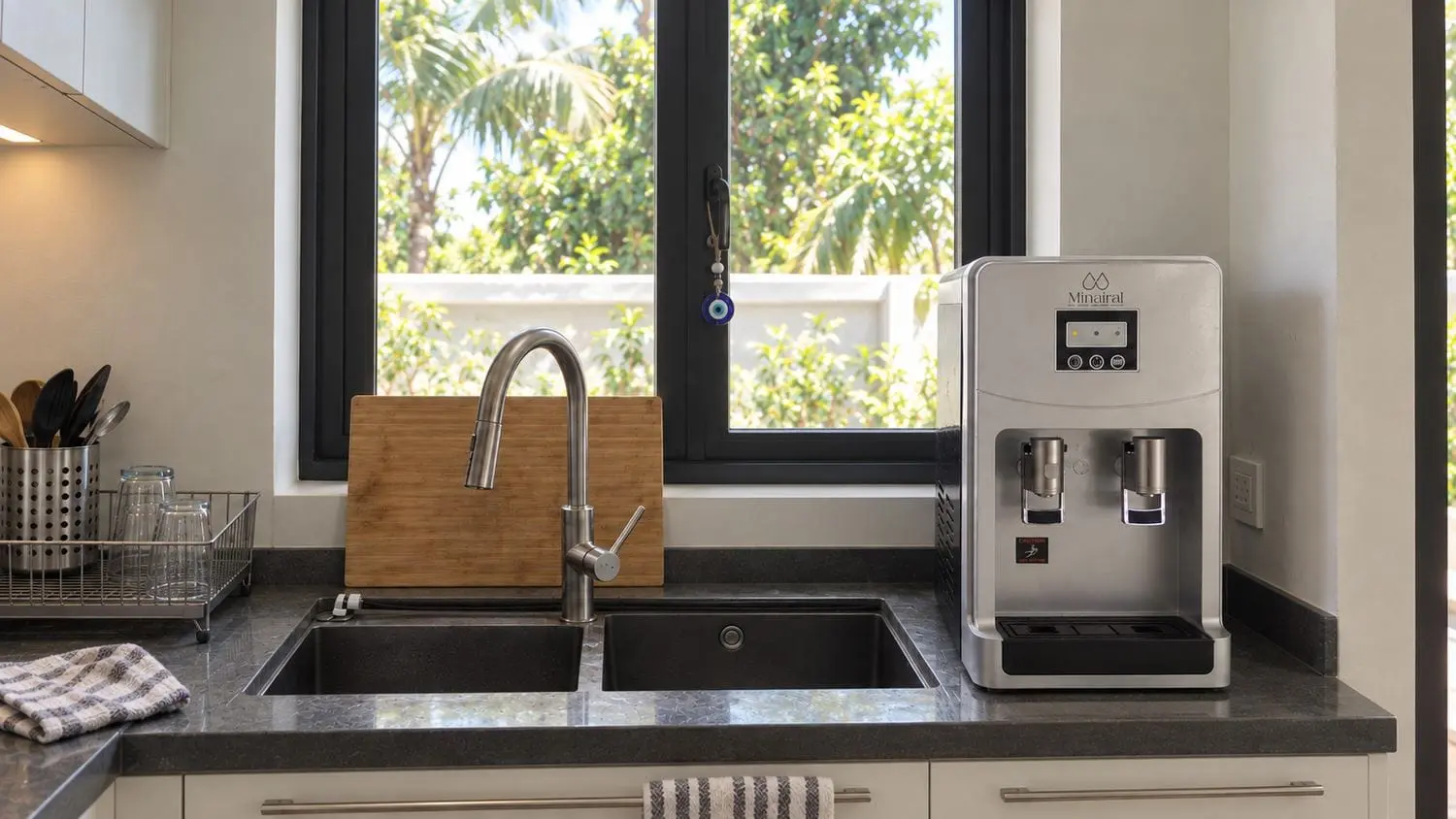
Boiling deals with microbes but not with salts, metals or taste. Bottled water solves the quality question at a high cost in plastic and deliveries. A point-of-use system treats the water where it is drunk: a five-stage reverse osmosis unit such as Pure removes dissolved solids and microbes from the building supply, then adds minerals back and protects the water with UV-C. Where the supply is unreliable, an atmospheric water generator makes drinking water from the humidity in the air with no connection to the mains. Our water quality page shows what comes out of both.
Frequently asked questions.
Can you drink tap water in Thailand?
The water leaving MWA and certified PWA plants meets drinking criteria, but the tap in your building is only as clean as the tank and pipes it passes through. Most Thai households boil, filter or buy water for drinking, and visitors are advised to do the same.
Is Thai tap water safe for brushing teeth and cooking?
Yes in cities on the MWA and PWA networks, where the water is chlorinated and monitored. Food that is boiled or cooked is safe; drinks and ice are where a filter or bottled water make a difference.
Does boiling make tap water safe?
Boiling for one minute kills bacteria, viruses and parasites. It does not remove salt, metals, nitrate or chlorine by-products, and it concentrates dissolved solids slightly, so it is a partial answer.
How often should a water tank be cleaned?
Waterworks recommend at least every six months, more often for open or rooftop tanks exposed to heat and dust. Ask for the cleaning record before you rent a condo or book a long stay.
Why does tap water smell of chlorine?
The utility keeps 0.2 to 0.5 mg/L of free chlorine in the network so that the water stays disinfected to the last tap. The smell fades if you let the water stand in an open jug for an hour, and a carbon filter removes it entirely.
If you run a hotel, an office or a villa and want drinking water that does not depend on the building supply, request a site assessment. Our team visits, tests the water and tells you honestly whether Pure, Air or neither is the right fit.