Atmospheric Water Generation Solving Global Scarcity
Water scarcity no longer belongs to a distant future. It is already shaping daily life for millions of people, from urban households dealing with unreliable supply to rural communities depending on unsafe sources. Climate change, population growth, groundwater depletion and ageing infrastructure have pushed traditional water systems to their limits.
In this reality, a new question is gaining attention across the world. What if clean drinking water did not need rivers, reservoirs, pipelines or bottled deliveries at all?
This is where atmospheric water generation enters the picture, not as a theory, but as a working, practical solution that is already changing how people think about water independence.
At Minairal, this shift is not just a concept. It is the basis of the Air range, built for high-humidity regions like Thailand.
Why Global Water Scarcity Is a Structural Problem, Not a Temporary Crisis
Water shortages are often treated as emergencies. Droughts make headlines. Trucked water becomes a temporary fix. Bottled water sales spike.
But the deeper issue runs far below the surface.
Groundwater reserves are shrinking faster than they can recharge. Urban populations continue to grow, placing enormous pressure on municipal water systems that were designed decades ago. In many regions, water quality is declining even where supply exists, forcing families to rely on filters, boiling or bottled alternatives.
The uncomfortable truth is that centralised water infrastructure alone cannot keep up with modern demand. Solving water scarcity requires decentralised, self-sufficient solutions that bring water closer to the point of use.
That is exactly what air to drinking water technology makes possible.
Understanding Atmospheric Water Generation in Simple Terms
Atmospheric water generation works on a principle that has existed since the beginning of nature. Air contains moisture. In humid environments, that moisture is abundant and renewable.
An atmospheric water generator pulls in ambient air, cools it to condense water vapour, then filters and mineralises the collected water to make it suitable for daily drinking.
If you want a deeper technical overview, read atmospheric water generation explained, or our guide to how atmospheric water generators work, which offers a clear breakdown of the process from intake to output.
What matters most for everyday users is not the science alone, but the outcome: clean water produced on demand, without depending on pipelines, tankers or plastic bottles.
Why Air to Drinking Water Is Gaining Global Momentum
The appeal of air to drinking water systems lies in their independence.
Unlike traditional sources, atmospheric water does not compete with agriculture, does not drain aquifers and does not require heavy infrastructure. It turns the surrounding environment into a resource rather than a limitation.
In humid regions like Southeast Asia, especially Thailand, the performance advantage is even stronger. Moisture-rich air allows systems to produce reliable volumes of water throughout most of the year.
- For households, this means control.
- For businesses, it means resilience.
- For communities, it means security.
From Concept to Everyday Use: The Rise of Water from Air Generators
A decade ago, many people viewed water from air generators as experimental or industrial. Today, they are being installed in homes, offices, cafes, clinics and remote locations where water access is uncertain.
The reason is simple. The technology has matured.
Modern systems are quieter, more energy-efficient and designed for daily use. Filtration and UV protection make the water fit to drink, and remineralisation gives it a taste and pH suitable for long-term consumption.
If you are looking for an overview grounded in real-world use, our air-to-water generator review offers helpful context.
Why Thailand Is a Perfect Environment for Atmospheric Water Generation
Thailand's climate creates an ideal environment for atmospheric water generators. Relative humidity sits within the systems' operating range of 30% to 80% for most of the year, and the air is warm and consistently moist.
This is why Minairal sizes and specifies its systems for Thai conditions, and quotes average daily output for exactly these conditions rather than a laboratory maximum.
A well-designed water from air generator in Thailand can operate reliably across seasons, providing households and businesses with steady access to clean water even when municipal supply fluctuates.
For customers who have experienced inconsistent tap water quality or the inconvenience of bottled deliveries, this shift feels transformative.
Inside the Minairal Atmospheric Water Generator Experience
Minairal is not positioned as a novelty product. It is built as a practical appliance for real life.
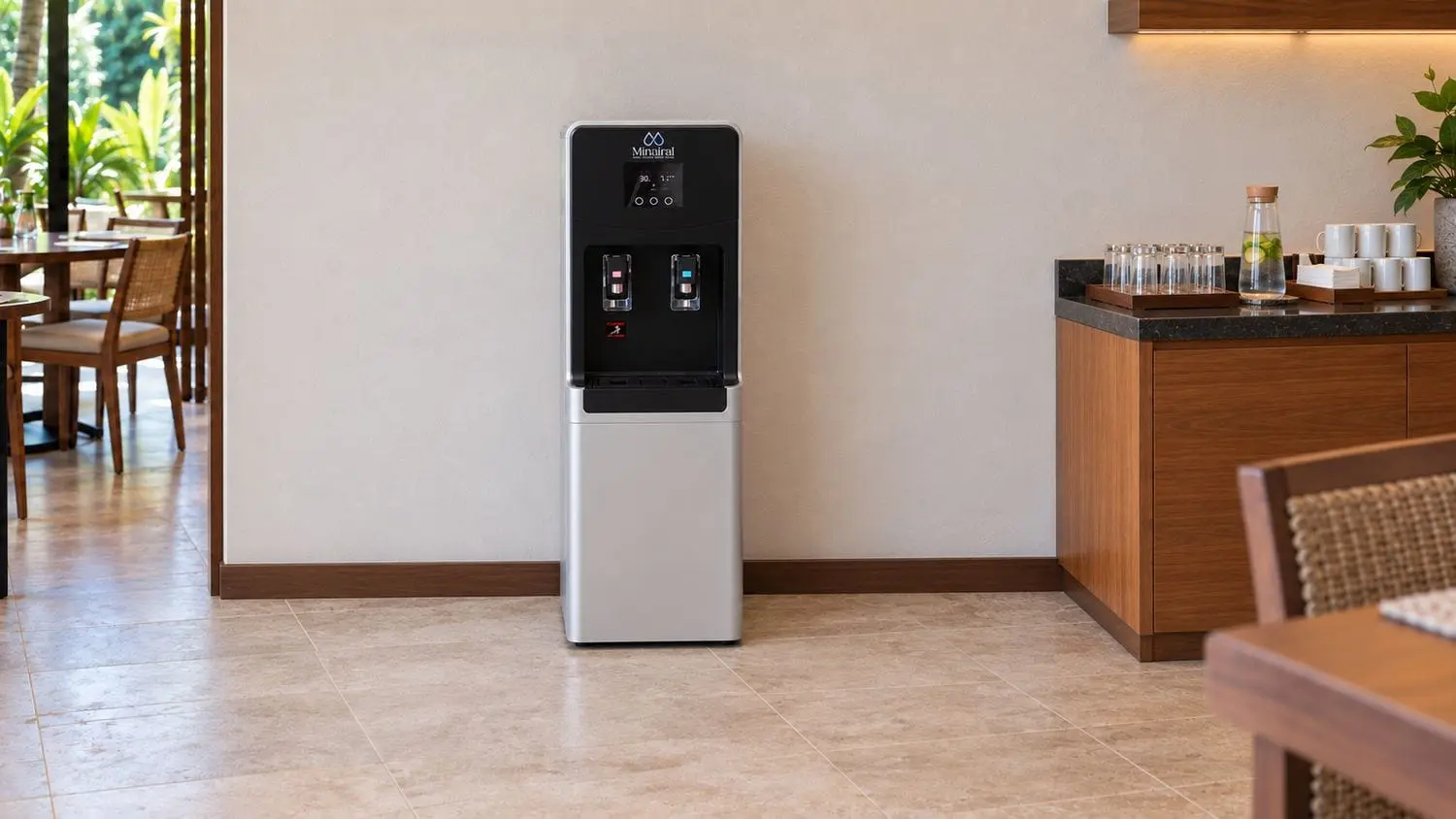
The system pulls moisture from the air, passes it through a multi-stage treatment process, and delivers mineral-rich alkaline water suitable for daily drinking. There are no pipes to install and no bottles to lift.
Just plug in the unit, choose your temperature, and drink.
With three models producing 13, 16 or 30 litres a day on average, Minairal supports families, offices, cafes and small commercial spaces without disruption. These are average daily outputs, for relative humidity between 30% and 80% and an average temperature of 25°C.
The built-in filtration removes airborne dust and particles, while UV protection safeguards the water at each stage. Calcium, magnesium, potassium and sodium are restored, for a smooth taste and an alkaline pH of 8.5 and above. The full treatment detail is on our water quality page.
Addressing the Real Question: Air Water Generator Price and Value
One of the most common questions buyers ask is about the air water generator price. It is a fair concern.
On the surface, atmospheric water systems appear to be an investment. But cost should always be evaluated in context.
Consider the ongoing expense of bottled water deliveries, storage space, plastic waste and transport emissions. Over time, these costs often exceed the one-time investment in an on-site solution.
Minairal focuses on transparent pricing and long-term value. The pre-filter is replaced every six months on Air systems and the other cartridges, including the reverse osmosis membrane, every twelve months, by our own technicians. There are no recurring delivery contracts or hidden charges.
For buyers comparing water from air generator options in Thailand, the real value lies in consistency, reliability and total cost of ownership. Prices for home users are listed on our online shop; for a business site, contact us for a site assessment.
Environmental Impact That Goes Beyond Water Access
Plastic waste has become one of the most visible environmental challenges of our time. Bottled water plays a significant role in this problem, especially in regions where recycling infrastructure is limited.
By producing water at the point of use, atmospheric water generation removes the need for plastic bottles entirely. It also reduces the carbon footprint associated with transport, storage and refrigeration. Our impact calculator shows the bottles and litres a system replaces on a given site.
Beyond plastic, these systems protect groundwater reserves by reducing dependence on wells and boreholes. This matters not just for today, but for future generations.
Who Benefits Most from Atmospheric Water Generation
The appeal of atmospheric water generation cuts across multiple audiences.
- Homeowners value independence and safety.
- Businesses value reliability and brand responsibility.
- Healthcare facilities value purity and control.
- Remote locations value access without infrastructure.
In Thailand, extended families, small offices, cafes, hotels and wellness centres are among the fastest adopters. The combination of climate suitability and growing awareness around water quality makes adoption a logical step rather than a luxury.
Why Minairal Stands Apart in the Market
Not all atmospheric water generators are built the same. Performance depends on climate suitability, filtration quality and long-term reliability.
Minairal is a Thai company based in Koh Samui, with over 700 systems installed and three service centres, in Koh Samui, Phuket and Hua Hin. Every system is installed and serviced by our own technicians, with parts held in country.
Customers choosing Minairal are not just buying a machine. They are investing in peace of mind, knowing that their water source is clean, consistent and under their control.
The Bigger Picture: Rethinking Water Independence
Atmospheric water generation will not replace rivers or rainfall. But it does something equally important.
It decentralises water access.
In a world where climate uncertainty is increasing, the ability to produce clean water locally becomes a form of resilience. It empowers households and businesses to take responsibility for their own supply rather than waiting for infrastructure to catch up.
This shift in thinking is already underway. Those who adopt early benefit first.
Final Thoughts: A Practical Path Forward
Water scarcity is not just an environmental issue. It is a quality-of-life issue.
Atmospheric water generation offers a realistic, scalable answer to one of humanity's most pressing challenges. It works with nature rather than against it, especially in climates like Thailand where air moisture is abundant.
Minairal represents this future in a form that fits modern living. Clean, mineral-rich air to drinking water produced where it is needed, when it is needed.
For anyone seeking a smarter way to secure daily hydration, this is no longer a distant idea. It is already here.
FAQs
How does air to drinking water technology work?
An atmospheric water generator draws in humid air, cools it below its dew point so the water vapour condenses, then filters the water, protects it with UV and restores minerals before dispensing it.
How much water can an atmospheric water generator produce per day?
Minairal Air systems produce 13 litres a day on average for the Air Top, 16 litres for the Air Stand and 30 litres for the Air Stand Pro, for relative humidity between 30% and 80% and an average temperature of 25°C.
Does it work in less humid conditions?
The systems operate between 30% and 80% relative humidity. In Thailand, humidity stays within that range for most of the year.
Does an air to water system need plumbing?
No. It plugs into a power socket. There is no inlet and no connection to the water network.
How is the water kept safe over time?
The pre-filter is replaced every six months on Air systems and the other cartridges, including the reverse osmosis membrane, every twelve months. TDS and pH are checked during routine maintenance.