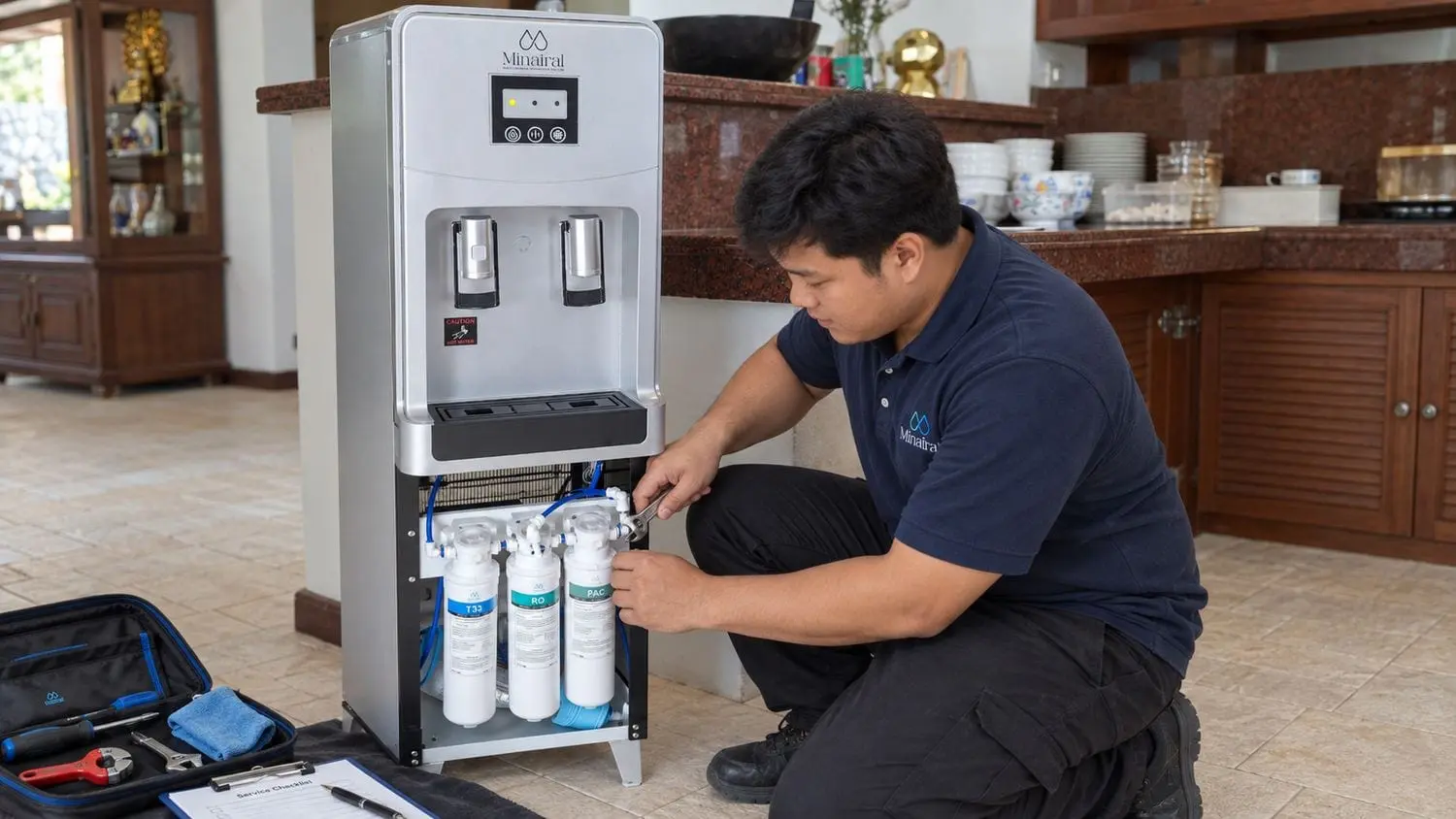
An atmospheric water generator is an appliance that runs every day, pulls air through itself and stores drinking water. Like any drinking water equipment, it stays safe because somebody maintains it. This article sets out what the maintenance of an air-to-water machine involves in practice: which filters are inside, how often each one is replaced, what a technician does during a service visit, and the small things an owner should do between visits.
Maintenance of an atmospheric water generator comes down to scheduled filter changes and water checks. On Minairal Air systems the pre-filter is replaced every six months, and the post-carbon filter, mineral filter and reverse osmosis membrane every twelve months. TDS and pH are checked at each visit, and business clients get an annual ISO 17025 laboratory test.
Why an air-to-water machine needs maintenance at all
Three things happen inside the unit that call for upkeep. First, air is drawn across the condenser all day, and air carries dust even in a clean room. Second, the condensed water passes through filter cartridges that trap particles and adsorb odours until they are full. Third, water sits in a tank between uses, and stored water needs protection. Each of those has a matching component, and each component has a replacement interval. The way the system treats water is described on our water quality page; this article covers keeping that treatment working.
The filters inside an atmospheric water generator
The exact configuration depends on the model. On the Air Stand Pro the treatment runs to seven stages, and the consumable ones are listed below.
- Air filter. Sits at the intake and stops dust before it reaches the condenser. It protects the coil and keeps the condensed water cleaner.
- Sediment and pre-filter. Removes particles from the condensed water. It is the filter that loads up fastest, which is why it has the shortest interval.
- Pre-carbon filter. Carbon filtration ahead of the membrane, where fitted.
- Reverse osmosis membrane. On the Air Stand Pro, filtration at 0.0001 micron.
- Post-carbon filter. The final polishing stage for taste and smell.
- Mineral filter. Restores calcium, magnesium, potassium and sodium through Biocera technology, for an alkaline pH of 8.5 and above and 40 to 80 ppm of total dissolved solids. When this cartridge is spent, the water is still filtered but gradually loses its minerals and its pH drops, which the TDS check picks up.
- UV protection. LED UV on the water line and a UV lamp in the tank. These are not cartridges, but they are checked as part of the service.
How often each filter is replaced
The intervals below are those applied by Minairal technicians on Air systems. For comparison, the table also shows the Pure range, which treats mains water and therefore loads its pre-filter faster.
| Component | Air systems (air-to-water) | Pure systems (reverse osmosis on the water line) |
|---|---|---|
| Sediment and pre-filter | Every 6 months | Every 4 months |
| Post-carbon filter | Every 12 months | Every 12 months |
| Mineral filter | Every 12 months | Every 12 months |
| Reverse osmosis membrane | Every 12 months | Every 12 months |
| TDS and pH check | Every visit | Every visit |
| Independent ISO 17025 laboratory test | Once a year on the business service plan | Once a year on the business service plan |
In practice that means two visits a year for an Air system: a six-month visit for the pre-filter and a twelve-month visit for everything else. The intervals assume normal use; a site with unusually dusty air, for example next to a construction site or an unpaved road, may need the air filter and pre-filter looked at sooner, and the technician will say so.
What the technician does during a service visit
A routine visit on a Minairal system follows the same sequence whether the unit sits in a hotel lobby in Phuket or an office in Bangkok:
- Inspection. The technician checks the unit, the air intake, the dispensing area and the tank, and asks about anything the client has noticed, such as a change in taste or flow.
- Filter replacement. The cartridges due at that visit are replaced with parts from stock. Several hundred spare parts are held in country, so a visit is not delayed by a shipment.
- Water check. TDS and pH are measured on the dispensed water and compared with the expected range, 40 to 80 ppm and pH 8.5 and above.
- Function check. Hot and cold delivery, where fitted, and the general operation of the system.
- Record. The visit and the parts replaced are recorded, so the next interval is known.
Minairal has thirteen people, eight of them in installation and maintenance, working from service centres in Koh Samui, Phuket and Hua Hin with coverage of Bangkok and Koh Phangan. Response is same day in most cases and 48 hours at the latest, Monday to Saturday, 9:00 to 18:00, in English and Thai. Each centre runs two to five technicians, so a scheduled visit and an unplanned call do not compete for the same person. How many units a hotel, an office or a school needs is covered in our guide to sizing a commercial atmospheric water generator.
What you do between visits
Very little, which is the point. A few habits keep the unit at its best:
- Keep the space around the air intake clear so air moves freely. A unit pushed into a tight cupboard or against a curtain breathes badly.
- Wipe the dispensing area and the drip tray as part of normal cleaning, as you would with any water dispenser.
- Leave the unit switched on. It is designed to run continuously, and the UV protection in the tank works while the machine is powered.
- Tell your technician about changes rather than waiting for the next visit: a different taste, slower flow, a noise. Most of these are a filter that is ahead of schedule.
Maintenance as part of the running cost
When comparing an atmospheric water generator with bottled water or a water cooler contract, maintenance is one of three lines in the running cost, alongside electricity (an Air machine draws between 370 and 500 W) and the purchase price. For a business site, Minairal quotes the configuration, the capacity and the maintenance plan together after a site assessment, so the yearly cost of consumables and visits is known before the unit is installed. The service plan for business clients also includes the annual test of the water by an independent ISO 17025 accredited laboratory. For a hotel or resort with several units, visits are grouped so the technician services all of them in one trip.
If you are weighing up an Air system or a Pure system for your site, request a site assessment and ask for the maintenance plan with the quote. If you are still deciding whether the technology makes sense for you, the comparison between an atmospheric water generator and a dehumidifier explains why the treatment and the maintenance behind it are what make the water drinkable.
Frequently asked questions
How often do you change the filters on an atmospheric water generator?
On Minairal Air systems the sediment and pre-filter is replaced every six months, and the post-carbon filter, mineral filter and reverse osmosis membrane every twelve months. On Pure systems, which treat mains water, the pre-filter is replaced every four months.
Can I replace the filters myself?
On business installations the replacement is done by Minairal technicians, who also check TDS and pH and record the visit. Doing it this way keeps the water within its expected range and keeps the service history complete. For a home unit, see our guide to an atmospheric water generator for the home in Thailand.
What happens if a filter is not replaced on time?
A spent pre-filter restricts flow and lets more particles through to the stages behind it. A spent mineral filter lets the pH and TDS drift down. Neither failure is sudden, which is why the fixed schedule and the TDS check at each visit matter.
Is the water tested?
TDS and pH are checked at every maintenance visit. On the business service plan, water produced on site is also tested once a year by an independent laboratory accredited to ISO 17025.
Does the unit need to be cleaned inside?
The stored water is protected by a UV lamp in the tank, and the water line by LED UV. Internal checks are part of the technician's visit; the owner only needs to keep the outside and the dispensing area clean. Day-to-day use at home is described in our review of the air-to-water machine for Thai homes.