In late July 2026 the Provincial Waterworks Authority (PWA) began rotating tap water supply across zones of Koh Samui. The island was producing about 40% of its normal clean water, and hotels at higher elevations were among the first to see taps run dry. For anyone running a hotel or a managed villa on the island, the question is what to do about it.
Minairal is based in Bo Phut, so we live with the same supply as our clients. This article sets out what the published figures say, what a shortage actually changes for a property, and where producing drinking water on site fits into the answer.
In short: Koh Samui's undersea pipeline delivers about 16,000 cubic metres of water a day while average demand is about 34,000, so rationing returns whenever reservoirs drop. A hotel cannot make its own mains supply, but it can make its own drinking water: an atmospheric water generator condenses it from humid air, with no water line and no deliveries.
What is happening to Koh Samui's water supply?
The figures below come from the Thai press and the PWA, not from Minairal. According to the Bangkok Post report of 29 July 2026, the underwater pipeline from the Surat Thani mainland supplies about 16,000 cubic metres a day, while average demand on the island is about 34,000 cubic metres. A prolonged dry spell, worsened by the El Niño pattern, had drained the island's reservoirs, and clean water production fell to roughly 40% of normal. The PWA rotated supply between zones, asked residents and businesses to store water when it was running, and said it hoped to push about 4,000 cubic metres more a day through the pipeline while repairing a damaged reverse osmosis treatment unit.
This is not the first episode. In April 2024, The Thaiger reported that the island's three wetland reserves, Phru Krajood, Phru Na Muang and Phru Chaweng, hold a combined 3.2 million cubic metres, and that private water trucks were already carrying water to hotels on high ground beyond the reach of the dwindling tap supply. Two days after the 2026 rationing announcement, the Bangkok Post reported tourism operators calling for greater investment in water infrastructure to keep pace with visitor numbers.
The island's own reserves are finite, the pipeline has a fixed capacity, and demand peaks in the same months the rain stops. The cycle is the same on the Andaman side, as our article on Phuket's reservoirs and tap water describes.
What does a water shortage change for a hotel or villa?
A property uses water in two very different ways, and a shortage hits them differently. For a managed villa the split is the same, as set out on our page on the drinking water set-up for villas.
Process water: showers, laundry, pools, gardens
This is the bulk of a hotel's consumption and it comes from the mains, from storage tanks or from trucked deliveries. When rationing starts, the usual responses are larger storage tanks, booking water trucks early, and cutting non-essential use. None of this is something a drinking water system solves. Hua Hin depends on a single dam in much the same way, as our article on Hua Hin's tap water and the Pranburi Dam recounts.
Drinking water: rooms, restaurants, pool, staff
This is a small share of total volume but the one guests notice most. Most properties on the island buy it in bottles, and on an island every bottle arrives by boat and then by truck. During a shortage, the same roads and the same logistics are busy with water trucks, and the bottle supplier is under the same pressure as everyone else.
Drinking water is the part of the problem a property can take fully in-house, with a supply that does not depend on the pipeline, the reservoirs or the delivery schedule. Boiling stored tap water is the fallback, with the limits set out in our article on whether boiled tap water is safe to drink.
Can a hotel produce its own drinking water during a shortage?
Yes, in two ways, and the choice depends on whether a water line can be trusted.
From the air, with no water connection
An atmospheric water generator draws in humid air, cools it below its dew point so the vapour condenses, then filters the water, protects it with UV and restores calcium, magnesium, potassium and sodium. It plugs into a socket and needs no inlet, so it keeps working whether the mains is flowing or not. Minairal's Air range produces 13, 16 or 22 litres a day on average (the Air Stand Pro reaches up to 30 litres), for relative humidity between 30% and 80% and an average temperature of 25°C. Koh Samui's climate sits comfortably in that range for most of the year.
From the line, when it is running
A Pure reverse osmosis system treats the existing line at 0.0001 micron and dispenses hot at 90°C and cold at 4°C. It gives a stable daily volume while the line runs, and it is the better fit for a kitchen or a staff area with a dependable connection. During rationing, though, it stops when the tap does. Many properties combine both: Pure where the line is reliable, Air where it is not or where there is no plumbing at all, such as a pool deck or a beach bar. The two technologies are compared in detail in our guide to air-to-water versus reverse osmosis versus bottled water.
How much drinking water does a property need?
The method we publish on this site counts two litres per person per day. Multiply by the people on site, and divide by the average daily output of the system.
| Property | People on site | Drinking water a day | Air Stand Pro units (22 L a day on average, up to 30 L) |
|---|---|---|---|
| Managed villa, 4 bedrooms | 8 | 16 L | 1 (or one Air Stand, 16 L a day on average) |
| Boutique hotel, 20 rooms | 40 | 80 L | 4 |
| Resort, 50 rooms | 100 | 200 L | 10 |
The count is an average, and the number and placement of units is set at the site assessment, because what matters is where people actually drink: the pantry that fills the room bottles, the lobby, the pool, the restaurant and the staff kitchen. A 50-room resort rarely puts ten units in one room. It spreads them across points of use, and often mixes Air and Pure. For the full method, see drinking water systems for hotels and resorts.
What else changes once drinking water is made on site?
- No bottle deliveries. At two litres a day in half-litre bottles, one guest present every day accounts for 1,460 bottles a year. A 100-guest resort stops moving 146,000 bottles across the island annually. Our article on cutting water deliveries with on-site generation goes through the logistics.
- No storage of pallets.
- Water quality that is documented. Minairal water is remineralised to a pH of 8.5 or above with 40 to 80 ppm of total dissolved solids, TDS and pH are checked at every routine maintenance, and the business service plan includes a yearly test by an ISO 17025 accredited laboratory.
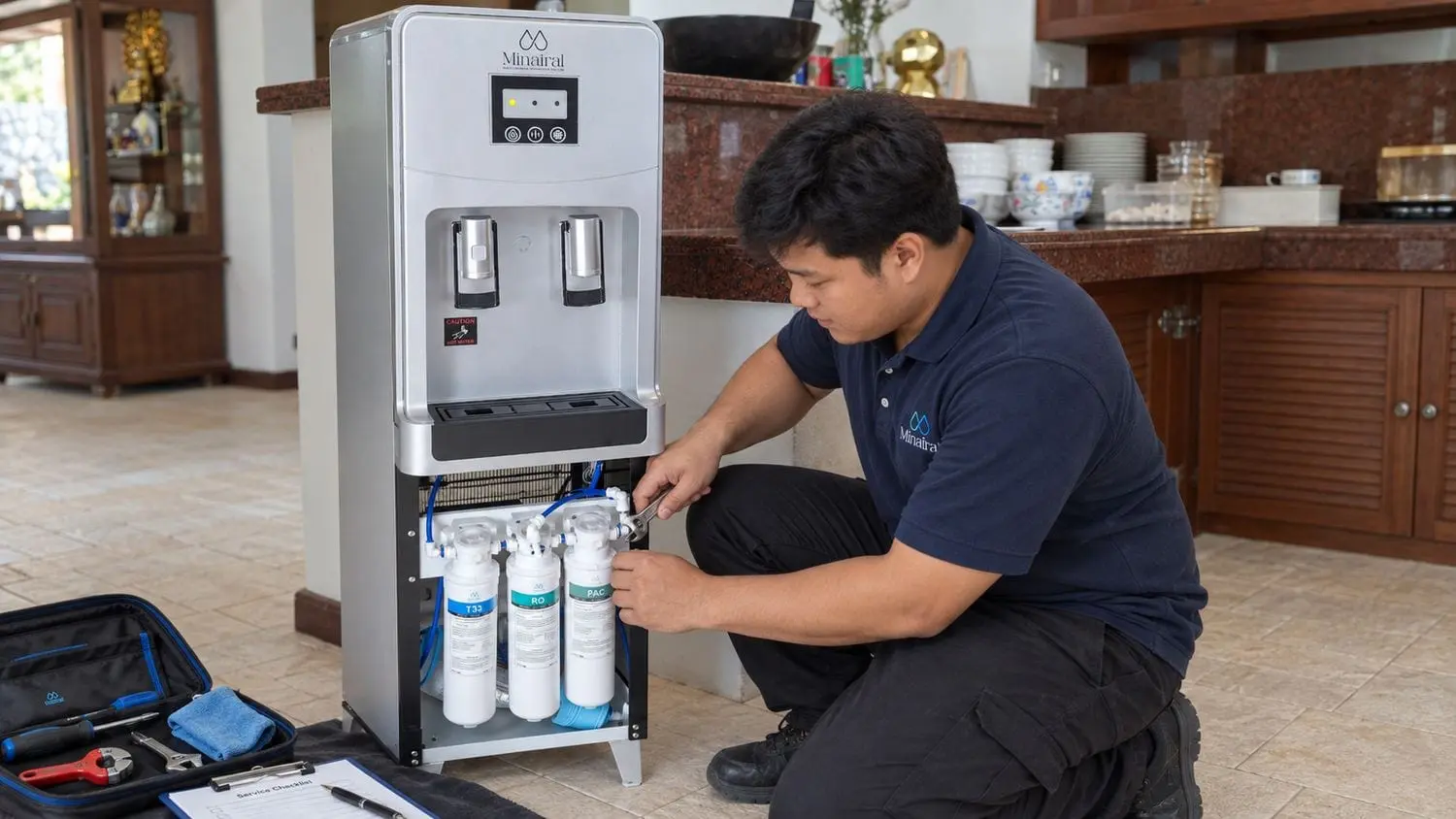
- A local service team. Our head office, showroom and service centre are in Bo Phut. Technicians are on our payroll, parts are held on the island, and response is same day in most cases, 48 hours at the latest, Monday to Saturday, 9:00 to 18:00.
What an atmospheric water generator does not do
It does not fill a swimming pool, run a laundry or replace the PWA. It produces drinking water, measured in litres a day per unit, from electricity and humid air. A property that needs 200 litres of drinking water a day and 50,000 litres of process water still needs its storage tanks and its supplier for the second figure. What it gains is that the first figure, the one guests taste, no longer depends on anyone else.
For the background on how the island's tap water is treated and why it is not meant to be drunk at the tap, read is tap water safe to drink in Koh Samui.
Frequently asked questions
Does an atmospheric water generator work during a water cut?
Yes. It needs electricity, between 370 and 500 W while running, and humid air, not a water line, so a mains interruption does not affect it.
Is there enough humidity in Koh Samui?
Minairal's Air systems operate between 30% and 80% relative humidity, and their daily figures are averages at 25°C. Koh Samui's coastal climate sits within that range throughout the year. An air-conditioned room is drier than an open one, so the assessment checks the room where each unit will stand.
Can the water be served in rooms without plastic?
Yes. Housekeeping fills an optional reusable 500 mL glass bottle from a system in the pantry. The bottle can carry the hotel's logo and prints the mineral composition of the water on its label.
Who installs and maintains the systems on the island?
Minairal technicians, from the Bo Phut service centre, with Koh Phangan served from the same base. One agreement covers survey, installation, staff training, maintenance and parts.
Where do we start?
Request a site assessment. Tell us the number of rooms, average occupancy, the outlets and where the water lines run. You receive a configuration, a capacity and a maintenance plan written for the property. Details for the island are on our Koh Samui and Koh Phangan page.