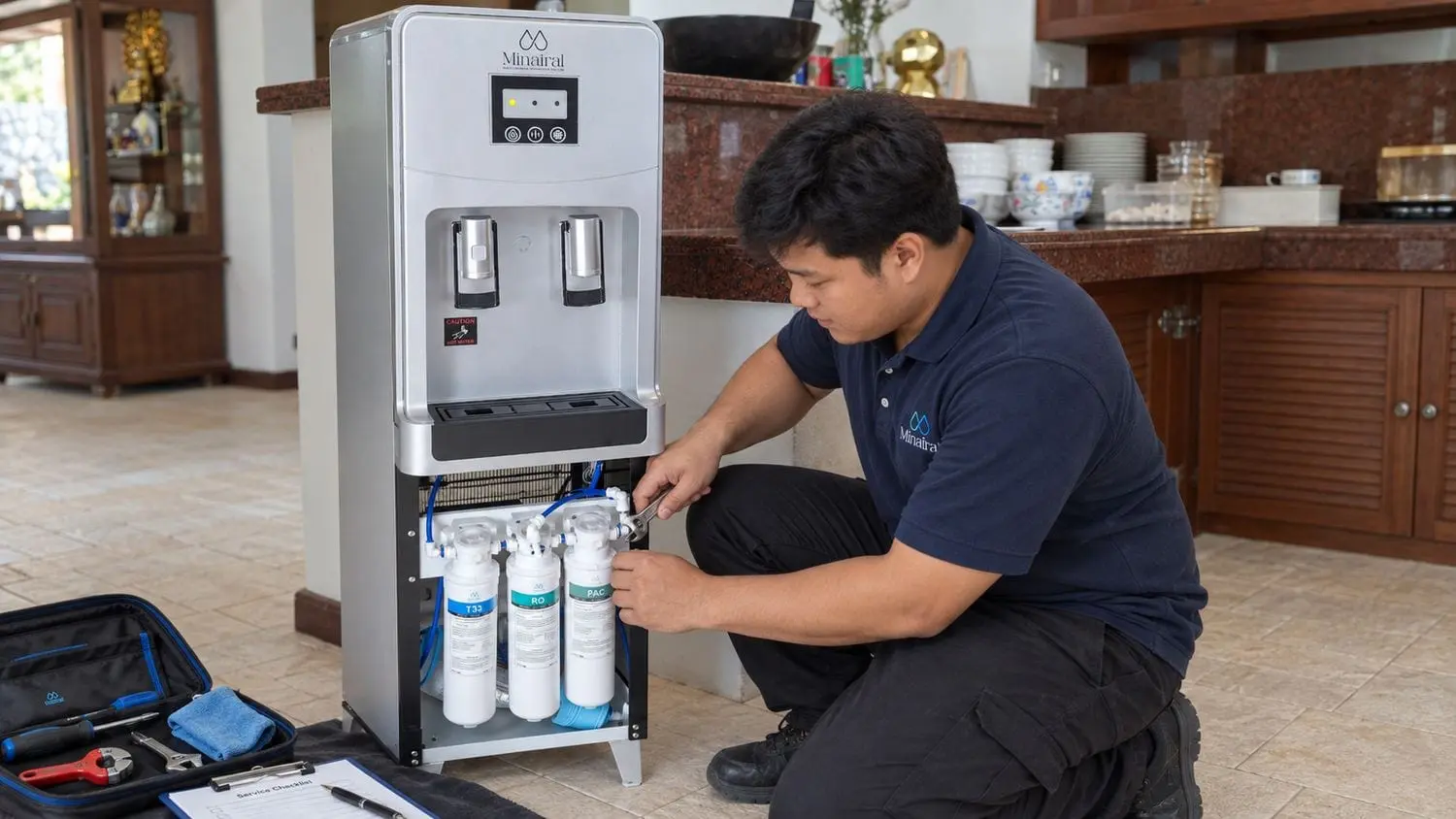
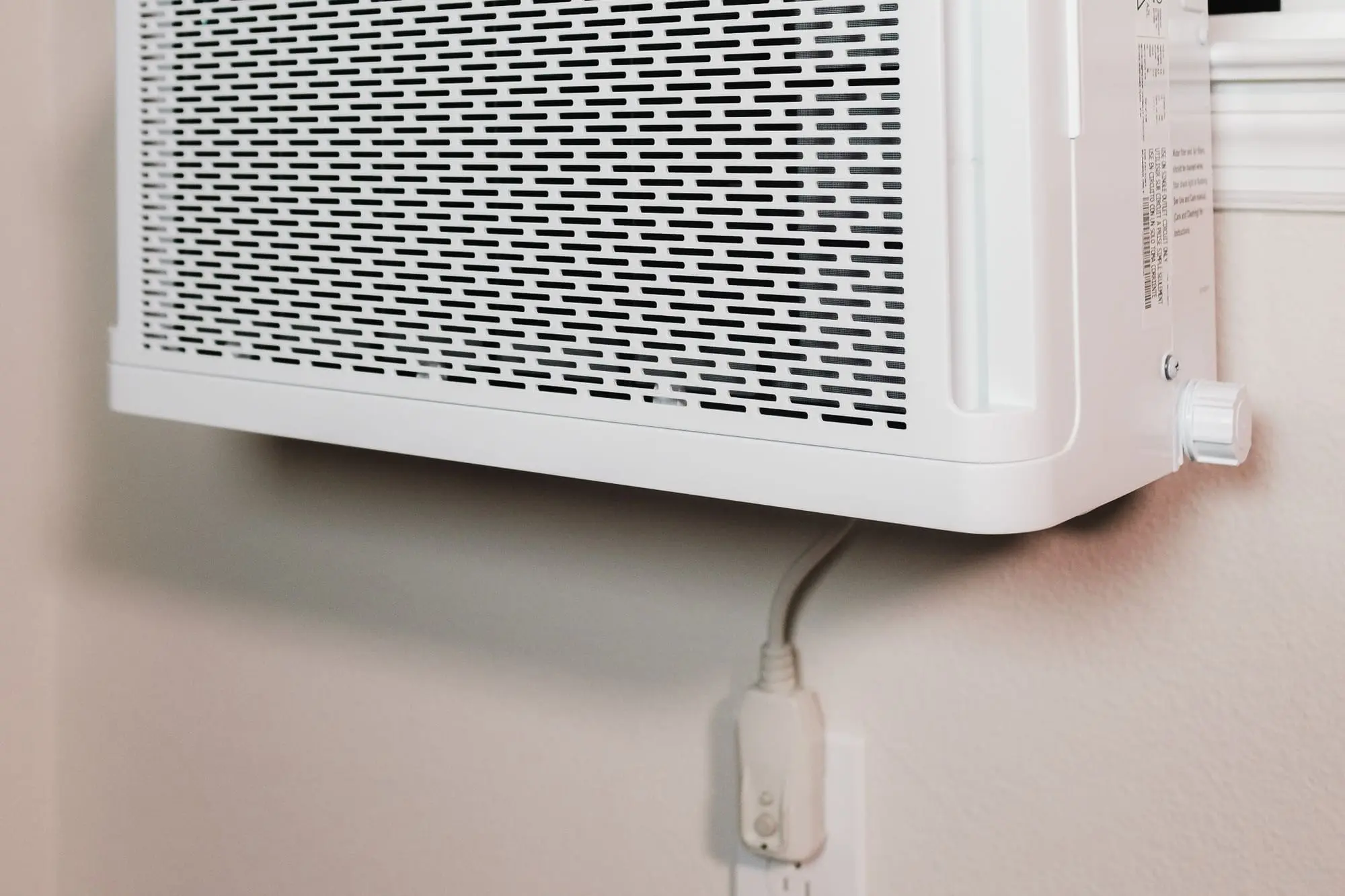
Anyone who has emptied the tank of a dehumidifier, or watched the drip from an air conditioner outside a Thai house, has had the same thought: that is a lot of water, and it came from the air. So what makes an atmospheric water generator different, and why is the water from a dehumidifier or an air conditioner not something you should drink? The physics is the same. Everything else is not.
No, you should not drink water from a dehumidifier or an air conditioner. It condenses on coils that are not food grade, collects dust and microbes from unfiltered air, and sits in an open pan. An atmospheric water generator uses the same condensation, then filters, sterilises and remineralises the water, and is serviced and tested as a drinking water appliance.
The physics both machines share
A dehumidifier, an air conditioner and an atmospheric water generator all do one thing first: they pull warm, humid air across a cold surface. When the air is cooled below its dew point, the water vapour it carries condenses into liquid, exactly as it does on the outside of a cold glass. The colder the coil and the more humid the air, the more water forms. Thailand's climate makes this easy, which is why air conditioners here drip all day. The condensation step is explained in detail in our guide on how atmospheric water generators work.
If condensation were the whole story, a dehumidifier would be a cheap water source. The difference lies in what the water touches, what was in the air, what happens to the water after it forms, and what the appliance was designed and tested to do.
Why dehumidifier and air conditioner water is not drinkable
The coil and the drain are not food grade
Dehumidifier and air conditioner coils are built to move heat, not to produce something you swallow. They are typically copper or aluminium, often with fins and coatings chosen for thermal performance, and the drain pan and hose are standard plastics. None of these components is specified for contact with drinking water, and none is cleaned to that standard.
The air is not filtered for drinking
A dehumidifier draws room air through a coarse dust screen at most. Everything in that air that is small enough to pass, dust, pollen, spores, soot from the road, lands on a wet coil. The condensate washes it into the tank.
The water stagnates
Condensate drips into an open pan or tank and sits at room temperature, in the dark, with no disinfection. That is the environment in which biofilm and mould grow, which is why dehumidifier tanks develop a smell if they are not emptied and scrubbed. Air conditioner drain lines are notorious for the same reason.
There are no minerals and no testing
Condensed water is close to distilled: flat in taste and empty of calcium and magnesium. More importantly, nobody has ever tested the water from your dehumidifier in a laboratory, and the manufacturer never intended anyone to drink it. The user manual usually says so.
That water is fine for plants, for a mop bucket or for the steam iron. It is not fine in a glass.
What an atmospheric water generator adds
An atmospheric water generator, or air-to-water machine, starts with the same condensation and then treats the result as the raw material for drinking water. On Minairal Air systems that means:
- Filtered intake air. Air passes through an air filter before it reaches the condenser, so the coil collects water, not dust.
- Water-contact components built for drinking water. The condensing and storage parts are designed and specified for the purpose.
- Filtration. The condensed water is passed through sediment and carbon stages, and on the Air Stand Pro through a reverse osmosis membrane rated at 0.0001 micron, for a seven-stage sequence in total.
- Sterilisation. LED UV on the water line and a UV lamp in the tank protect the stored water, which is the step a dehumidifier lacks entirely.
- Remineralisation. A mineral filter using Biocera technology puts calcium, magnesium, potassium and sodium back, for an alkaline pH of 8.5 and above and 40 to 80 ppm of total dissolved solids. The treatment is described on our water quality page.
- Service and testing. The pre-filter is replaced every six months and the other cartridges every twelve. TDS and pH are checked during routine maintenance, and under the business service plan the water is tested once a year by an independent ISO 17025 accredited laboratory.
Side by side
| Dehumidifier or air conditioner | Atmospheric water generator | |
|---|---|---|
| Purpose | Dry or cool the air; water is a by-product | Produce drinking water; dry air is the by-product |
| Air intake | Coarse dust screen or none | Air filter before the condenser |
| Water-contact materials | Heat exchanger metals, standard plastics | Specified for drinking water |
| Treatment after condensation | None | Sediment, carbon, reverse osmosis on the Air Stand Pro |
| Disinfection | None | LED UV on the line, UV lamp in the tank |
| Minerals | None | Calcium, magnesium, potassium, sodium restored |
| Storage | Open pan or tank | Closed tank, UV protected, dispensed hot and cold or cold |
| Maintenance | Empty and scrub the tank | Scheduled filter changes, TDS and pH checks, annual lab test on the business plan |
Could you filter dehumidifier water yourself?
People ask this, and the honest answer is that you would be rebuilding an atmospheric water generator by hand, badly. A jug filter does nothing against bacteria. Boiling kills microbes but not what leached from the coil and the pan. A home reverse osmosis unit needs pressure, and you would still have an unfiltered intake and an open, unprotected tank upstream. By the time the chain is complete, you have spent more than the machine designed for the job and have no way to prove the result is safe.
Which one do you need?
If the problem is a damp room or a hot one, buy a dehumidifier or an air conditioner and pour the condensate on the garden. If the problem is drinking water, the question is whether you have a reliable water line. If you do, a reverse osmosis system on the existing line is the simpler and lower-cost option. If you do not, or the supply is unreliable, as in many villas and residences on the islands, an Air system produces 13, 16 or 22 litres a day on average (the Air Stand Pro up to 30 L), for relative humidity between 30% and 80% and an average temperature of 25°C, with no connection to the mains at all. Home models are listed with prices on our online shop, and for a business site you can request a site assessment.
Frequently asked questions
Is water from an air conditioner safe to drink?
No. It condenses on a coil that is not built for drinking water contact, carries whatever was in the unfiltered air, and runs through a drain line where biofilm grows. Use it for plants or cleaning, not for drinking.
Is dehumidifier water distilled water?
It is close to distilled in mineral content, but it is not sterile and not clean. Distilled water from a still has been boiled and condensed in a closed system; dehumidifier water has been condensed on an open coil in room air.
Is an atmospheric water generator just a dehumidifier with a filter?
The condensation step is similar. The difference is the filtered intake, the water-grade components, the multi-stage filtration, the UV sterilisation, the remineralisation, and the maintenance and testing behind it. The water from a Minairal Air system has an alkaline pH of 8.5 and above and 40 to 80 ppm of total dissolved solids.
Can I use dehumidifier water for cooking if I boil it?
Boiling deals with microbes but not with metals or residues from the coil and pan. It is better kept for non-food uses.