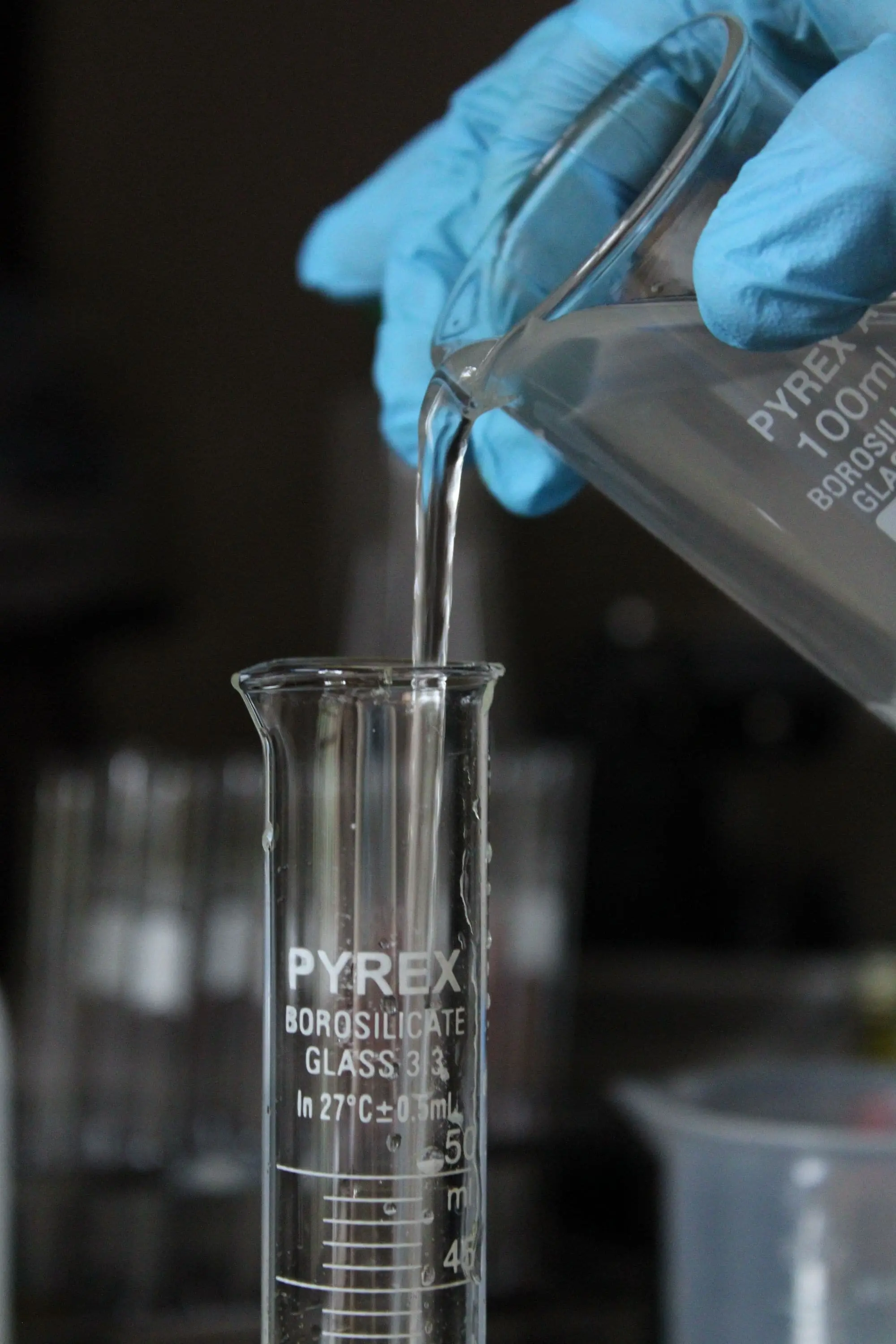
TDS, or total dissolved solids, is the total amount of minerals, salts and other substances dissolved in water, expressed in milligrams per litre. For drinking water there is no health limit: the World Health Organization sets no health-based guideline for TDS and treats it as a measure of taste, rating water below about 600 mg/L as good and above about 1,000 mg/L as increasingly unpalatable.
In Thailand, bottled water must stay under 500 mg/L of total solids and the Department of Health criteria for tap water allow 1,000 mg/L. A TDS reading tells you how much is dissolved in the water, not whether the water is safe.
This guide explains what the number means, what typical Thai waters measure, why a very low reading is not a goal in itself, and how to use a TDS meter without being misled by it.
What does a TDS number actually measure?
Dissolved solids are mostly the minerals water picks up from rock and soil: calcium, magnesium, sodium, potassium, bicarbonate, chloride and sulphate. The number also includes any dissolved metals, nitrate and organic matter, and it is blind to what each one is. A handheld TDS meter does not count anything; it measures how well the water conducts electricity and converts that to an estimate in mg/L, because dissolved salts conduct and pure water does not.
That is why a meter cannot see bacteria, viruses, pesticides or microplastics, none of which conduct electricity. It is a useful number and a limited one.
What TDS level is good for drinking water?
The scale most often quoted comes from WHO taste panels and is reproduced in guidelines from Canada and Australia.
| TDS (mg/L) | Taste rating |
|---|---|
| Under 300 | Excellent |
| 300 to 600 | Good |
| 600 to 900 | Fair |
| 900 to 1,200 | Poor |
| Over 1,200 | Unacceptable |
These are ratings of taste, not of safety. The WHO notes that water with very low TDS can taste flat and that very high TDS causes scale in kettles and pipes. Thai rules add two fixed limits: total solids in bottled drinking water may not exceed 500 mg/L under Ministry of Public Health Notification No. 61, and the Department of Health surveillance criteria for tap water set 1,000 mg/L.
What is the TDS of tap, bottled, RO and mineral water in Thailand?
Readings vary by source and season, but typical ranges help you place your own number.
| Water | Typical TDS (mg/L) | Note |
|---|---|---|
| Bangkok and provincial tap water | 100 to 400 | Rises in the dry season when seawater pushes up the Chao Phraya |
| Well water on islands and in villas | 200 to over 1,000 | Hard, sometimes salty; the case for RO |
| Thai bottled purified water | 10 to 100 | Usually RO, sometimes remineralised |
| Bottled mineral water | 100 to 500 | Taste comes from the mineral mix, not the total |
| RO water without remineralisation | Under 30 | Flat taste, slightly acidic |
| Remineralised RO or water from air | 50 to 150 | Calcium and magnesium added back |
Water made by the Air range starts near zero, because condensed water carries nothing dissolved, and is then remineralised with calcium, magnesium, potassium and sodium. The Pure range strips the building supply with a five-stage RO and adds the same minerals back. Both land in the 50 to 150 range, which is where most people find the taste right. Our water quality page gives the details.
Is a lower TDS always better?
No. Sellers of RO units sometimes demonstrate a reading near zero as proof of purity, and sellers of alkaline or mineral products sometimes present a high reading as proof of richness. Both miss the point. A reading of 5 mg/L tells you the water has no minerals and will taste flat; a reading of 300 mg/L from a well could be mostly calcium, which is harmless, or partly sodium chloride, which is not what you want. Only a proper analysis tells you which.
The useful question is not how low but what is in it. For drinking, a moderate TDS made of calcium and magnesium tastes best and is what remineralisation aims for. We explain the related claims about pH in what is alkaline water 9.5, and we make no health claims about TDS in either direction.
How do you measure TDS at home or in an office?
- Buy a pen-type TDS meter; basic models cost a few hundred baht. Check that it reads in ppm or mg/L, which are the same for this purpose.
- Rinse the probe, let the water reach room temperature and take the reading in a clean glass. Warm water reads higher.
- Measure the tap, then the filtered or dispensed water. The gap between the two shows what the filter is removing.
- Record the number monthly. A steady rise after an RO membrane is a sign the membrane is ageing; a sudden jump at the tap means the supply changed.
- Calibrate once a year with a standard solution, or replace the meter.
A TDS meter is a monitoring tool, not a safety test. For coliform, nitrate or metals, send a sample to a certified testing service.
Why does TDS matter for a filter or a water system?
For reverse osmosis, TDS is the main sizing parameter. A membrane removes 90 to 98% of dissolved solids, so a feed of 300 mg/L gives about 10 to 30 mg/L after the membrane. Higher feed TDS means more pressure, more reject water and a shorter membrane life, which is why a technician measures it before recommending a unit. It also sets the filter schedule: on hard well water the pre-filter and membrane work harder and need changing sooner than on Bangkok tap water.
Frequently asked questions.
What TDS is safe to drink?
There is no health-based limit. Water from 50 to 600 mg/L tastes good to most people, and Thai standards allow 500 mg/L in bottled water and 1,000 mg/L in tap water. Safety depends on what the solids are and on microbes, which a TDS meter does not see.
Is 0 TDS water good to drink?
It is safe but tastes flat and is slightly acidic. Most people prefer water with some calcium and magnesium, which is why RO systems and water from air are usually remineralised.
What is the TDS of Bangkok tap water?
Typically in the low hundreds of mg/L, higher in the dry season when the river turns brackish. The MWA publishes current readings by district.
Does a high TDS mean the water is contaminated?
Not by itself. High TDS usually means hard or salty water. Contamination by bacteria or chemicals can occur at any TDS and needs a different test.
What is the difference between TDS and hardness?
Hardness counts only calcium and magnesium; TDS counts everything dissolved. Hard water always has a fairly high TDS, but a high TDS can also come from sodium and chloride in soft, salty water.
If you want to know the TDS of your building's water and what system fits it, request a site assessment; our team measures it on the spot.